

Highlights
This article is available as a YouTube podcast.
Updated six times since publication.
Considering the popularity of this article, additional sections have been added to respond to user questions. The YouTube podcast reflects data as of April, 2025.
There are distinctions between legal and illegal immigration and crime. Separating the two is necessary for understanding a crime connection.
Illegal immigration, however, lacks the checks and balances designed to keep out the violent and those willing to hurt Americans.
The total number of unauthorized border crossings since 2021 exceeds 12 million. Some estimates, including statements from House Speaker Mike Johnson, suggest the number could be closer to 16 million. Others say it’s 20 million.
According to the Pew Research Center, the U.S. had an estimated 14 million unauthorized immigrants living in the country as of mid-2023, a record high. This figure includes people who entered without authorization and others who entered legally but lack full legal status (e.g., asylum seekers, parolees, those under temporary protection). Some advocacy or research groups — for example, the Federation for American Immigration Reform (FAIR) — produce higher estimates (e.g.,18.6 million in 2025) based on alternative modeling methods.
Per data from the Bureau of Justice Statistics, “noncitizens prosecuted in U.S. district courts are less likely to have a known criminal history than U.S. citizens. Approximately 44% of noncitizens and 60% of U.S. citizens had a known criminal history.
Forty-four percent of prosecuted immigrants with criminal histories suggests the possibility that millions of illegal immigrants with criminal backgrounds have entered the United States.
Per CNN, nearly 70% of ICE arrests are of illegal aliens charged or convicted of a crime in the U.S.,” a Homeland Security spokesperson said in a statement, citing more than 700,000 deportations under the Trump administration. Note that this addresses illegal aliens charged or convicted of a crime in the U.S. If we included charges or convictions in their country of origin, the percentage would be much higher.
More than 13,000 immigrants convicted of homicide — either in the United States or abroad — are living outside of Immigration and Customs Enforcement detention, according to data ICE provided to Congress.
Per CNN, 56 percent of those polled state that the country should deport illegal immigrants, a huge increase. Sixty-one percent of independents agree.
A summary of the immigration and crime data is below and in the Appendix.
CrimeinAmerica.Net-Chat GPT’s “Top 10 Sources for Crime in America” based on primary statistical sources with trusted secondary analysis.
100 out of a possible 100 score based on website trust, content, and links, Gridinsoft.com.
Author
Leonard Adam Sipes, Jr.
Former Senior Specialist for Crime Prevention and Statistics for the Department of Justice’s clearinghouse. Former Director of Information Services, National Crime Prevention Council. Former Adjunct Associate Professor of Criminology and Public Affairs-University of Maryland, University College. Former police officer. Retired federal senior spokesperson.
Former advisor to presidential and gubernatorial campaigns. Former advisor to the “McGruff-Take a Bite Out of Crime” national media campaign. Produced successful state anti-crime media campaigns.
Thirty-five years of directing award-winning (50+) public relations for national and state criminal justice agencies. Interviewed thousands of times by every national news outlet, often with a focus on crime statistics and research. Created the first state and federal podcasting series. Produced a unique and emulated style of government proactive public relations.
Certificate of Advanced Study-The Johns Hopkins University.
Author of ”Success With The Media: Everything You Need To Survive Reporters and Your Organization” available at Amazon and additional bookstores.
Crime in America.Net-“Trusted Crime Data, Made Clear.”
Quoted by The Associated Press, USA Today, A&E Television, the nationally syndicated Armstrong Williams Television Show (30 times), Department of Justice documents, multiple US Supreme Court briefs, C-SPAN, the National Institute of Health, college and university online libraries, multiple books and journal articles, The Baltimore Sun, The Capital Gazette, MSN, AOL, Yahoo, The Daily Beast, The Huffington Post, JAMA, News Break, The National Institute of Corrections, The Office of Juvenile Justice And Delinquency Prevention, The Bureau of Justice Assistance, Gartner Consulting, The Maryland Crime Victims Resource Center, Law.Com, The Marshall Project, The Heritage Foundation via Congressional testimony, Law Enforcement Today, Law Officer.Com, Blue Magazine, Citizens Behind The Badge, Police 1, American Peace Officer, Corections.Com, Prison Legal News, The Hill (newspaper of Congress), the Journal of Offender Monitoring, Inside Edition Television, Yomiuri Shimbun (Asia’s largest newspaper), LeFigaro (France’s oldest newspaper), Oxygen and allied publications, Forbes, Newsweek, The Economist, The Toronto Sun, Homeland Security Digital Library, The ABA Journal, The Daily Express (UK) The Harvard Political Review, The Millennial Source, The Federalist Society, Lifewire, The Beccaria Portal On Crime (Europe), The European Journal of Criminology, American Focus and many additional publications.
Sign up for notice of new articles on the front page of this site.
A comprehensive overview of crime for recent years is available at Violent and Property Crime Rates In The U.S.
Quote
“Most of the 238 men rounded up by federal immigration agents and deported to a Salvadoran prison do not have criminal records in the U.S. “or elsewhere in the region…..” The Marshall Project daily newsletter.
Analysis: Per the US Department of Justice, the overwhelming majority of what we call crime is not reported to law enforcement, most crimes are not solved, and prosecutors dismiss a high number of cases; thus, data indicating that illegal immigrants don’t show up in official records through arrests and incarcerations offers little proof that they are law-abiding.
Mexico, Central and South American countries, with very high rates of crime and organized crime-drug smuggling, are not well known for keeping accurate records; thus, the lack of a criminal history for illegal immigrants could be meaningless.
Article
There are hundreds of answers I could provide regarding crime in America. I can give you rates, who is victimized, where the victimized live, how much they make, what happens if you resist, how many victims know their attacker, and many other topics.
However, I cannot definitively answer your questions about immigrants and crime due to a lack of reliable or recent research. All the studies below depend on a count of arrests or incarcerations.
When considering that the overwhelming majority of crime is not reported to law enforcement, anyone (native-born or immigrant) could easily be engaged in criminal activity and not show up in official records.
US Department of Justice data does not include immigration status except for federal prisons, and a reference (below) showing that crime reporting in immigrant communities is low and criminal history records from other countries are unreliable.
I conducted a literature review through Google and Chat GPT, and the majority of articles and literature will tell you that the immigrant and crime problem is exaggerated. But the data coming to that conclusion is often old, or the methodology is inadequate.
Regardless, data on immigration and crime are below. Newer sections have been added to respond to user questions.
Deportations and Presidents
Immigration enforcement didn’t begin with the current Trump administration. Under prior presidents, 7 million removals occurred under laws passed by Congress, and ICE today is enforcing those same laws. All numbers are approximations via ChatGPT.
President Obama was responsible for the removal of 3 million illegal immigrants. President Bush removed 2 million, and Clinton removed 1 million. During President Trump’s first administration, there were approximately 935,000 deportations.
The Border Czar, Tom Homan
In November 2024, Donald Trump designated Thomas Douglas Homan as “border czar” for Trump’s second presidency. Homan also served during the Obama administration and the first Trump administration.
In 2013, Obama appointed Homan as Executive Associate Director of Enforcement and Removal Operations (ERO) at ICE, the division responsible for identifying, detaining, and removing noncitizens with final orders of removal. While he carried out enforcement priorities consistent with that administration, he was also recognized with the Presidential Rank Award in 2015 for his work.
Homan served under Presidents Reagan, George H.W. Bush, Clinton, George W. Bush, Obama, and Trump.
Explaining Administrative Warrants
An administrative warrant is an internal ICE document used for civil immigration enforcement. It’s not signed by a judge and doesn’t carry the same authority as a criminal warrant, per several analysts.
ICE can use it to arrest someone in public, but it doesn’t authorize entry into homes or require state and local police to hold someone. Most of today’s controversy stems from the gap between what Congress authorized administratively and what the Constitution requires judicially.
An administrative warrant is not a judicial warrant. It is issued inside the executive branch, signed by a DHS or ICE official, not a judge, and authorized under the Immigration and Nationality Act (INA) for civil immigration enforcement. The most common forms are: Form I-200 – Warrant for Arrest of an Alien, Form I-205 – Warrant of Removal/Deportation.
Congress authorized ICE to use them to: Arrest individuals suspected of being removable, detain individuals pending removal, and execute final orders of deportation. They are civil tools, not criminal process.
Brief Summation Of The Data: Crime And Immigrants
Per CNN, nearly 70% of ICE arrests are of illegal aliens charged or convicted of a crime in the U.S.,” a Homeland Security spokesperson said in a statement, citing more than 700,000 deportations under the Trump administration. Note that this addresses illegal aliens charged or convicted of a crime in the U.S. If we included charges or convictions in their country of origin, the percentage would be much higher.
Two Groups
There are two groups of immigrants, legal and illegal. Separating the two is necessary for understanding a crime connection.
Legal immigrants seem to commit fewer crimes, but offending acts are parallel with those of native-born Americans. “There is, however, evidence that crime rates for the second and third generation rise to more closely match the general population of native-born Americans. If this trend is confirmed, it may be an unwelcome aspect of integration, National Academies of Sciences, Engineering, and Medicine, 2015.
There is a chart from the National Institute of Justice of the USDOJ illustrating the point of the National Academy of Sciences as to trend lines:
Chart–All Crime
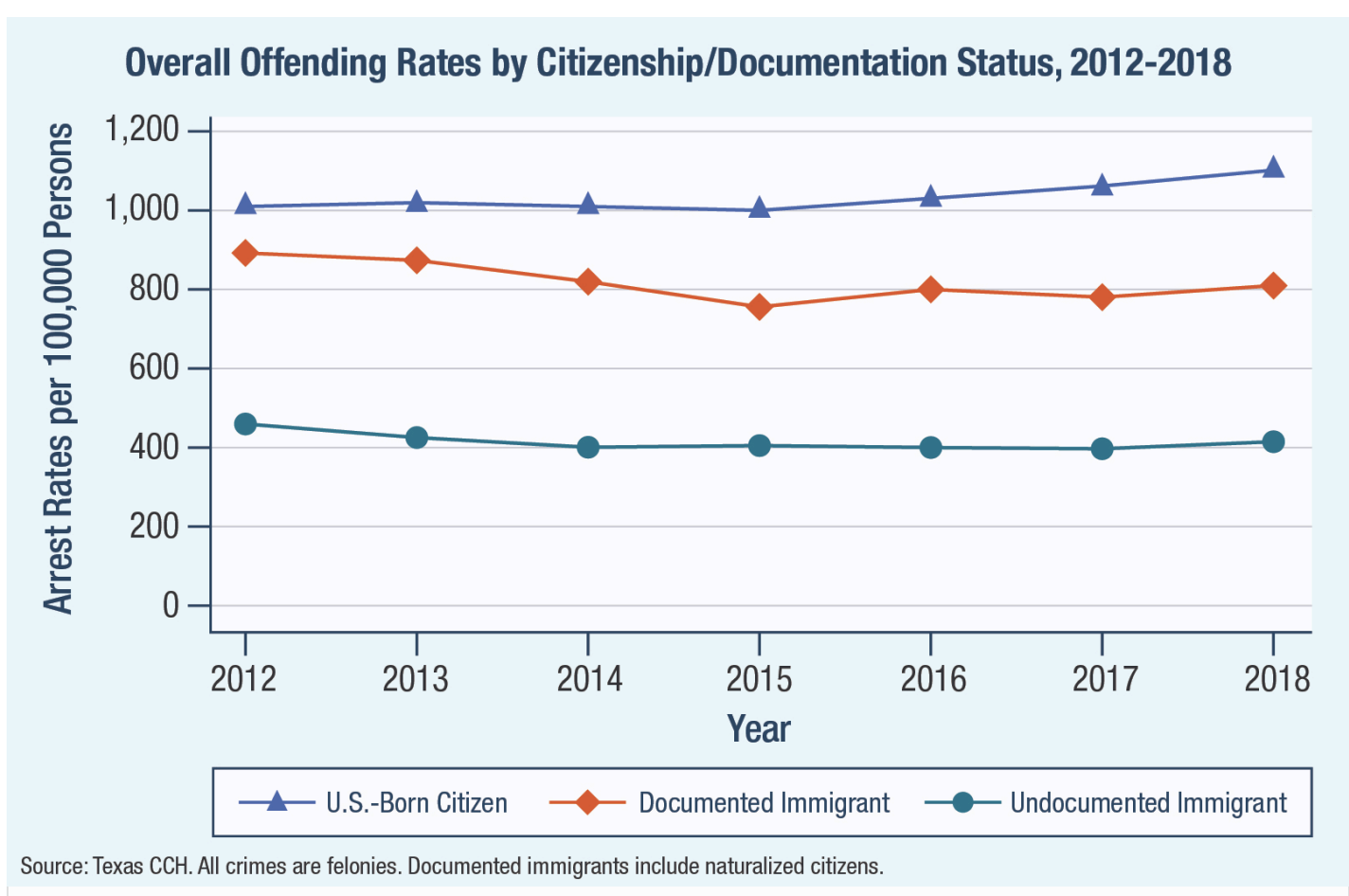
It confirms the National Academy of Sciences’ observation that the trend line for legal immigration parallels that of U.S.-born citizens. See a description below of the study, plus a chart on violent crime.
Illegal Immigrants
For illegal immigrants, based on limited data, their crime connection seems to be low, but the research is insufficient based on dubious methodology (i.e., counting arrests and incarcerations). The overwhelming majority of crimes are not reported to law enforcement. Arrests and crimes solved have greatly declined; thus, incarcerations are rare.
There are organizations and media outlets definitively stating that immigrants do not commit crimes in great numbers. That’s a challenging statement to make because of the age of data and iffy (methodologically incorrect) research.
Some declare that immigrants (and immigrant gangs) are creating huge crime problems, and where that’s possible, again, we lack good data from the research community.
As someone who has studied (and taught) criminology, I’m aware of the crime problems associated with immigrants in the past. Note that it’s harsh discrimination that often creates a “circling of the wagons” within immigrant communities, which creates the desire to embrace organized criminal elements. When possible, that should be avoided.
More Data on Immigration and Crime (I will add my observations as appropriate)
National Institute of Justice-USDOJ (2024): The question of how often undocumented immigrants commit crimes is not easy to answer (emphasis added). Most previous research on crime commission by immigrant populations has been unable to differentiate undocumented immigrants from documented immigrants. As a result, most studies treat all immigrants as a uniform group, regardless of whether they are in the country legally.
The estimates in this study come from Texas criminal records that include the immigration status of everyone arrested in the state from 2012 to 2018. These data enabled researchers to separate arrests for crimes committed by undocumented immigrants from those committed by documented immigrants and native-born U.S. citizens.
The researchers tracked these three groups’ arrest rates across seven years (2012-2018) and examined specific types of crime, including homicides and other violent crimes. They used these arrest rates as proxies for the rates of crime commission for the three groups.
It should be noted that arrest is a commonly used, but imperfect measure of crime that in part reflects law enforcement activity rather than actual offending rates (emphasis added).
During this time, undocumented immigrants had the lowest offending rates overall for both total felony crime and violent felony crime compared to other groups. U.S.-born citizens had the highest offending rates overall for most crime types, with documented immigrants generally falling between the other two groups.
Chart-Violent Crime
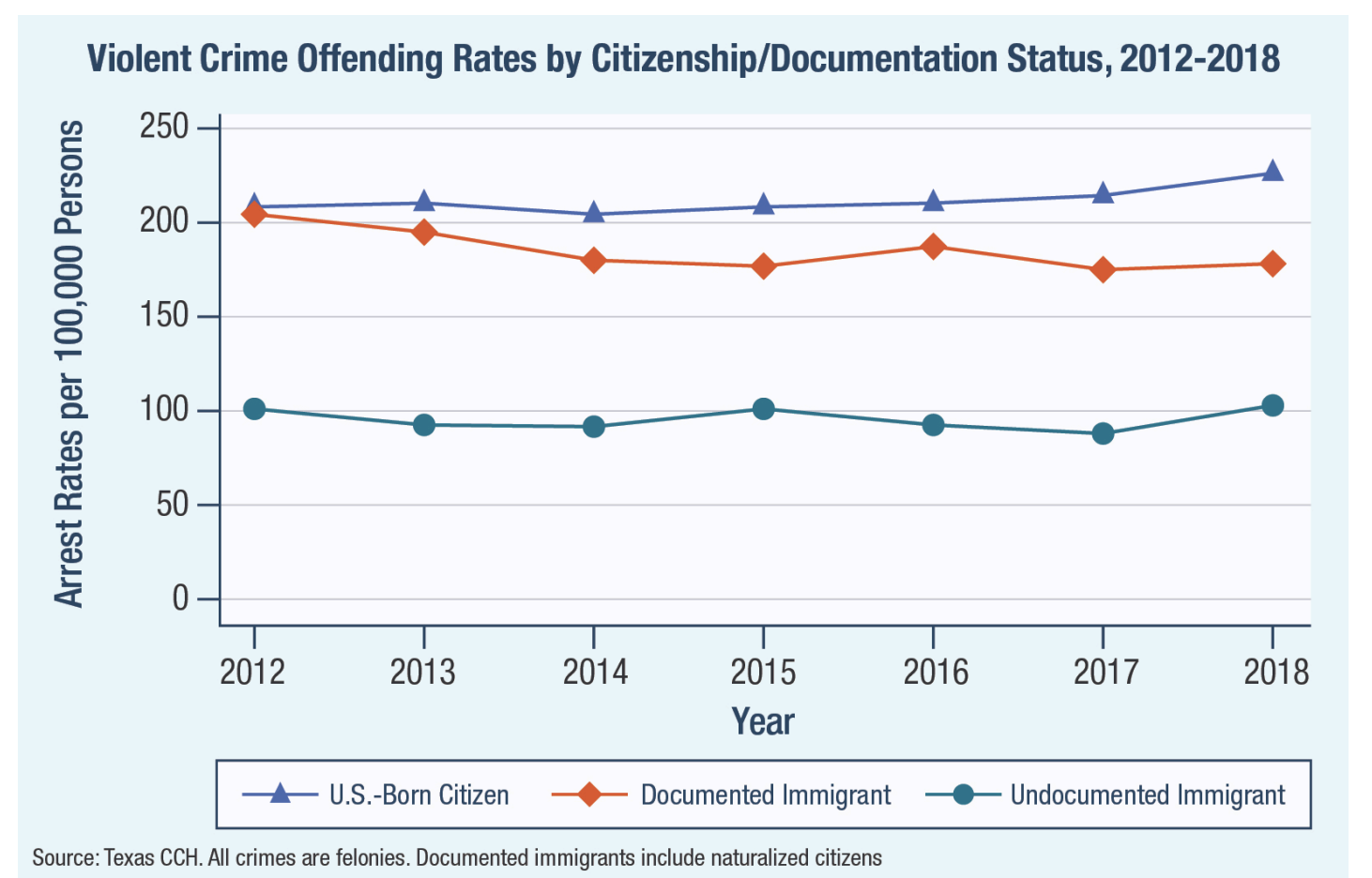
My Observation: The National Institute of Justice confirms that the use of arrests is a commonly used, but it’s an imperfect measure of crime.
What Most People Don’t Understand About Immigration Enforcement
ICE authority comes primarily from the Immigration and Nationality Act (INA), Title 8 of the U.S. Code. Congress criminalized unlawful entry into the United States in the early 20th century, but simply being present without authorization has always been a civil violation, not a crime. Deportation is civil enforcement, not criminal punishment.
The U.S. Constitution repeatedly uses the word “persons,” not “citizens.” The Supreme Court has been explicit that non-citizens physically present in the United States — including those here without authorization — are protected by core constitutional rights, including due process and protection from unreasonable searches and seizures.
Congress has authorized ICE to arrest and detain removable noncitizens under civil immigration law and to prioritize enforcement against those with criminal histories. However, Congress has not exempted ICE from the Constitution. All immigration arrests remain subject to the Fourth Amendment, and all noncitizens physically present in the United States are entitled to due process.
What Congress has not done is clearly define the operational boundaries between civil immigration enforcement and constitutional protections. That lack of clarity puts officers, communities, and civil liberties on a collision course. Clear statutory guidance would protect the public, preserve constitutional rights, and provide certainty to the officers tasked with enforcing the law.
Immigration status affects removability, not constitutional rights during apprehension.
Immigration enforcement is primarily federal. State and local police cannot arrest someone simply for being in the country illegally, because unlawful presence is a civil violation, not a crime. Local officers can arrest undocumented immigrants for state crimes, criminal immigration offenses, or if they’re operating under a formal federal agreement like 287(g). Outside those narrow circumstances, immigration arrests remain the responsibility of the federal government. Criminal immigration offenses are violations of federal immigration law that Congress has explicitly made crimes, as opposed to civil violations like unlawful presence.
News And Data Overviews
NBC News (2024): More than 13,000 immigrants convicted of homicide (emphasis added) — either in the United States or abroad — are living outside of Immigration and Customs Enforcement detention, according to data ICE provided to Congress earlier this week. A 2016 DHS Inspector General’s report found 368,000 criminal immigrants were not detained by ICE. According to ICE’s fiscal year 2023 budget justification, there were 405,786 convicted criminal immigrants on the non-detained docket as of June 5, 2021, NBC.
Associated Press (2024): ICE said 662,556 people under its supervision were either convicted of crimes or face criminal charges. Nearly 15,000 were in its custody, but the vast majority — 647,572 — were not, AP.
Northwestern University Study (2024): Analyzing 150 years of U.S. Census data, this study found that immigrants are consistently less likely to be incarcerated than U.S.-born individuals. Notably, since 1960, immigrants have been 60% less likely to be incarcerated compared to native-born Americans, NU.
My Observation: Incarceration is an imprecise method of judging crime. The overwhelming majority of crimes are not reported, especially in immigrant communities. The great majority of all crimes are not solved by law enforcement. A large percentage (20-30 percent) of crimes are not prosecuted.
American Immigration Council Analysis (2024): This analysis indicated that between 1980 and 2022, as the immigrant share of the U.S. population more than doubled from 6.2% to 13.9%, the total crime rate dropped by 60.4%. Specifically, violent crime decreased by 34.5%, and property crime fell by 63.3%, Immigration Impact.
My Observation: Again, the great majority of crimes are not reported. The Council is an advocacy organization. FBI data is notoriously unreliable. Per the National Crime Victimization Survey’s last official report, violence in America increased by 44 percent. Per the FBI’s last official report, violent crime decreased by three percent.
University of Wisconsin–Madison Study (2020): This study found that counties with larger undocumented immigrant populations tend to have lower crime rates. UW.
Some Data Is Old And Precedes The Massive Immigration Of Recent Years
A principal organization studying immigration and crime (Cato) bases its research on arrests and convictions, indicating that there is no direct connection between immigration and crime.
My Observation: As stated, the vast majority of crimes are not reported to the police. Crimes solved have plummeted to record lows. It’s not unusual for any prosecutor in the United States to dismiss large numbers (20-30 percent) of criminal cases, especially if the matter can be resolved through alternative means like deportation. In New York, an alarming 94 percent of domestic-violence cases are being dismissed. There is data from the Bureau of Justice Statistics indicating that 50 percent of select federal crimes are dismissed.
Their report is from 2019, well before the massive immigration of later years. For these reasons, the data is instructive but fundamentally flawed.
The lack of crime reporting, unsolved crimes, and prosecutor discretion leaves millions of crimes unaccounted for via arrests and convictions, especially when you consider that the Bureau of Justice Statistics of the USDOJ suggests that immigrants are less likely to report their victimizations to law enforcement.
An older report than above on the Criminalization of Immigration in the United States by The American Immigration Council is based on FBI data stating that:
Between 1990 and 2013, the foreign-born share of the U.S. population grew from 7.9 percent to 13.1 percent, and the number of unauthorized immigrants more than tripled from 3.5 million to 11.2 million.
During the same period, FBI data indicate that the violent crime rate declined 48 percent, which included falling rates of aggravated assault, robbery, rape, and murder. Likewise, the property crime rate fell 41 percent, including declining rates of motor vehicle theft, larceny/robbery, and burglary.
My Observation: Depending on vastly underreported FBI data and a small percentage of solved crimes proving that crime by immigrants is low, it seems dubious from a quality research point of view.
There’s No Doubt
Based on the NBC and Associated Press reports, there’s no doubt that significant numbers of people with criminal histories have illegally crossed the border. We simply do not know how many.
The total number of unauthorized border crossings since 2021 exceeds 12 million. Some estimates, including statements from House Speaker Mike Johnson, suggest the number could be closer to 16 million. Others claim that the illegal immigrant population is 20 million.
It’s unlikely for illegal immigrants not to contain people with criminal records and ties to organized gangs, regardless of official records.
Most illegal immigrants come from Central and South America, and these places have some of the highest rates of violence and crime in the world. Some come to escape. Some come to victimize. The level of organized criminal enterprises and drug smuggling in Central and South America is immense. Many suggest that these gangs arranged for illegal immigration to aid their criminal activities.
Past Immigration Is Instructive
Criminology and sociology discuss past immigration in terms of criminality and gang behavior. Every immigrant group in America had its share of good, decent people looking to create a new, law-abiding life.
Concurrently, every immigrant group had its share of people involved in criminal enterprises. Immigrants in the past faced discrimination, and “organizations” (including criminal organizations) were a solution.
As a child, my uncle told me about the immense abuse suffered by Irish Catholics, where terms like “Dogs and the Irish not welcome” were hung in storefronts. Like every other immigrant group, the Irish started their own stores, banks, and associations because of open (and accepted) oppression. Organized crime and gangs followed. Like all organized crime, protection was offered for a price, and politicians were bribed. Needed (stolen) goods were acquired and offered at reasonable prices, appreciated by the community. Accepted community norms were enforced, sometimes through violence.
Immigrants have always established for themselves what was acceptable behavior in their communities and the consequences for violations.
Why Would Today’s Immigrants Be Any Different?
Sociologists tell us that cities are machines for integrating the minority into the majority. Immigrants create their own media, businesses, and institutions to cope in a strange and often hostile land. Immigrants often don’t know the language proficiently, don’t like the food, and cling to their norms and customs that offer comfort.
Crimes Not Reported- 44% Of Noncitizens Had A Criminal History- Inadequate Records
I’m repeating this endlessly, but it’s important for understanding the data presented; per the US Department of Justice, the overwhelming majority of what we call crime is never reported to law enforcement, thus data indicating that illegal immigrants don’t show up in official records offers little proof that they are law-abiding.
Central and South American countries with very high rates of crime are not well known for keeping accurate records; thus, the lack of a criminal history for illegal immigrants could be meaningless.
Per data from the Bureau of Justice Statistics, “Noncitizens prosecuted in U.S. district courts are less likely to have a known criminal history than U.S. citizens. Approximately 44% of noncitizens and 60% of U.S. citizens had a known criminal history. This difference in criminal histories may be attributable to incomplete or unavailable records describing convictions for criminal offenses in other countries (emphasis added).”
Forty-four percent of prosecuted immigrants with criminal histories suggests the possibility that many illegal immigrants with criminal backgrounds may have entered the United States.
Data from the FBI and the National Crime Victimization Survey clearly state that most violent crimes involve people who know each other, and those crimes often do not get reported to the police. Immigrants are well known for not reporting their victimizations, especially when it involves other immigrants.
Criminologically speaking, there’s always been a code within immigrant communities not to “snitch.” Not telling the cops that your neighbor beat the crap out of you in a drunken rage was accepted in immigrant communities. Why? Because police would rarely take action. Why? Because local gang leaders would extract retribution (protection rackets) for a price, or you would do it yourself. Why? Because you are afraid of deportation or the deportation of your attacker (a sin within immigrant communities).
Poverty-Age
Finally, all research connects overall crime and illegal immigration with economic status, confirming that most are poor. If there is any criminological variable most associated with crime, it’s age and poverty, a consistent finding in every sociological or criminological study. Most immigrants are young and poor.
Media Reports
I read crime reports daily, and there isn’t a day that goes by without a reference to illegal immigrants committing a violent crime. I could easily add many additional examples.
I assume that the steady drumbeat of news on immigrants and crime influences public opinion. CNN states that there is considerable and growing support for deporting illegal immigrants. Fifty-six percent of Americans agree with this policy. Sixty-one percent of independents agree.
Can you make an empirical judgment call about illegal immigrants and crime based on media reports? No. But lacking good data, people are going to be persuaded that there is a relationship between illegal immigration and crime. Examples:
Kate Steinle (San Francisco, 2015)
Crime: Homicide. Details: Kate Steinle was shot and killed on a San Francisco pier by José Inés García Zárate, an undocumented immigrant from Mexico with multiple prior deportations and felony convictions. He claimed the shooting was accidental, and he was acquitted of murder and manslaughter, but the case became a rallying cry for stricter immigration enforcement and led to political scrutiny of sanctuary city policies.
Tessa Tranchant & Allison Kunhardt (Virginia Beach, 2007)
Crime: DUI Manslaughter. Details: These two teenage girls were killed when Alfredo Ramos, an undocumented immigrant from Mexico with prior alcohol-related convictions, slammed into their vehicle while driving drunk. The case drew attention to local law enforcement’s lack of coordination with immigration authorities.
Mollie Tibbetts (Brooklyn, Iowa, 2018)
Crime: Homicide. Details: Mollie Tibbetts, a college student, was abducted and murdered while jogging. The suspect, Cristhian Bahena Rivera, was an undocumented immigrant from Mexico who had been living and working in Iowa under a false identity. He was convicted of first-degree murder in 2021.
Ronil Singh (Newman, California, 2018)
Crime: Officer killed in the line of duty. Details: Police Corporal Ronil Singh was shot and killed during a traffic stop by Gustavo Perez Arriaga, an undocumented immigrant and gang member with a criminal history. The case reignited debates around California’s sanctuary laws and how they affect police safety.
Pierce Corcoran (Knoxville, Tennessee, 2018)
Crime: Vehicular Homicide. Details: Pierce Corcoran, a 22-year-old college student, was killed in a head-on crash caused by Francisco Eduardo Franco Cambrany, an undocumented immigrant who was later charged with criminally negligent homicide and deported. The case was cited by local politicians as an example of preventable crime.
There are endless additional media accounts I could bring to the discussion, including criminal “tourists” legally flying into the country from South America to commit burglaries of expensive homes. Why? because they believe that America offers easy opportunities for crimes. They believe that they will not be caught. If caught, deportation rather than prison is the likely result.
Immigrant Communities and Organized Crime
Every major immigrant group brings with it—or develops—its own forms of organized criminal activity, often operating beneath the surface and outside official crime statistics:
-
Mexican cartels and Central American gangs like MS-13 exploit immigrant flows and engage in human trafficking, drugs, and protection rackets.
-
Chinese tongs and triads, Russian mafias, and Eastern European fraud rings operate within ethnic enclaves.
-
West African scam networks, Middle Eastern smuggling operations, and Caribbean criminal gangs have established footholds in U.S. cities.
These groups focus on fraud, trafficking, extortion, cybercrime, and underground economies—crimes that are often invisible to the public and law enforcement unless proactively reported and investigated. In-group violence is common.
And again, many of their victims are immigrants themselves. Most crime stays within groups regardless of immigration status.
Final Thoughts
Concerns about immigration and crime shouldn’t be dismissed as xenophobia—but they also shouldn’t be based on fear, rumor, or one-off headlines. The full picture requires looking at what’s measured and what’s missed, at what gets reported and what stays silent, and at how communities protect—or exploit their own.
This is based on the history of crime, criminology, and sociology. There was a time when we thought that the Irish, Chinese, Jews, Italians, Eastern Europeans, and other groups were hotbeds of criminality. While repugnant to our sensibilities today, there was violence, gangs, and organized crime in just about every group entering America.
Immigration from Central and South America probably emulates that experience. I do not doubt that there are millions of people escaping violence and many perpetuating it.
Regardless, until I know otherwise, I treat all immigrants with basic courtesy and respect because acceptance of legal immigrants reduces the need to retreat into their own organizations and prompts their acceptance of American norms.
Illegal immigration, however, lacks the checks and balances designed to keep out the violent and those willing to hurt Americans. If you are here illegally, there is no proof that you are not a threat, while recognizing that criminal records from other countries are not nearly as robust as ours, and American criminal records are filled with inaccuracies.
Depending on criminal histories from foreign countries do not guarantee law-abiding behavior. There are possibly millions of immigrant criminals with no foreign criminal histories.
U.S. Immigration and Customs Enforcement
See the website at https://www.ice.gov/detain/detention-management
Note
This article includes mostly original writing and assistance from ChatGPT and a Google search. All sources were verified and reviewed for relevance.
Privacy Policy
We do not collect your personal information. See our privacy policy at “About This Site.”
See More
See more articles on crime and justice at Crime in America.
Most Dangerous Cities/States/Countries at Most Dangerous Cities.
US Crime Rates at Nationwide Crime Rates.
National Offender Recidivism Rates at Offender Recidivism.
The Crime in America.Net RSS feed (https://crimeinamerica.net/?feed=rss2) provides subscribers with a means to stay informed about the latest news, publications, and other announcements from the site.
You say “my observations” and yet their is no byline on this article?
Hi: All of my articles at https://crimeinamerica.net carry my name and background. What you’re reading probably comes from another source via my RSS feed. Len.