Summation
This article is available as a YouTube podcast.
Statistics on parole and probation from the Bureau of Justice Statistics are offered for 2023. 2024 data will be offered this Summer.
The use of parole has plummeted.
See an overview of technical violations.
The number of offenders on parole and probation has decreased significantly, from nearly 4,750,000 in 2013 to approximately 3,800,000 in 2023.
77 percent of males were on probation for a felony when the characteristics were known.
43 percent of felony probationers were serving time for a violent crime. If you include criminal history, the percentage would be much higher.
66 percent of those on parole were serving time for a violent offense. If you include criminal history, the percentage would be much higher.
Felonies and violent crimes are an increasing percentage of parole and probation caseloads.
Crime in America.Net-Chat GPT’s “Top 10 Sources for Crime in America” based on primary statistical sources with trusted secondary analysis.
Author
Crime in America.Net-“Trusted Crime Data, Made Clear.”
Quoted by The Associated Press, USA Today, A&E Television, the nationally syndicated Armstrong Williams Television Show (30 times), Department of Justice documents, US Supreme Court briefs, C-SPAN, the National Institute of Health, college and university online libraries, multiple books and journal articles, The Huffington Post, JAMA, The National Institute of Corrections, The Office of Juvenile Justice And Delinquency Prevention, The Bureau of Justice Assistance, Gartner Consulting, The Maryland Crime Victims Resource Center, The Marshall Project, The Heritage Foundation via Congressional testimony, Law Enforcement Today, Law Officer.Com, Blue Magazine, Corections.Com, Prison Legal News, The Hill (newspaper of Congress), the Journal of Offender Monitoring, Inside Edition Television, Yomiuri Shimbun (Asia’s largest newspaper), LeFigaro (France’s oldest newspaper), Oxygen and allied publications, Forbes, Newsweek, The Economist, The Toronto Sun, Homeland Security Digital Library, The ABA Journal, The Daily Express (UK) The Harvard Political Review, The Millennial Source, The Federalist Society, Lifewire, The Beccaria Portal On Crime (Europe), The European Journal of Criminology, American Focus and many additional publications.
Sign up for notice of new articles on the front page of this site.
A comprehensive overview of crime for recent years is available at Violent and Property Crime Rates In The U.S.
Quote
New Jersey Spotlight News: “Plumeri told lawmakers in the budget hearings that parole officers need to know where a parolee is living and need to have regular communication with them as a matter of public safety; he said parolees are told the importance of following all the rules and that their parole can be revoked if they do not comply with all the conditions of their release.”
“The simplification of technical parole violations is much more complex, in my view,” Plumeri said. “We take public safety very, very seriously, and we don’t just cavalierly violate people … What we do in terms of those violations are meaningful, and they’re not without steps that we haven’t taken.”
Article
Parole and probation data can be confusing. I’ll try to bring some clarification to the issue.
Below is a recent, yearly collection of data from the states and the federal government, submitted to the US Department of Justice through the Bureau of Justice Statistics for 2023.
The term “parole” includes mandatory or supervisory releases (when the state or federal government can no longer legally hold the offender). Traditional parole is a discretionary release from a parole commission.
There is no parole in federal corrections. Inmates serve 85 percent of their sentences, and they are under supervision for the remaining 15 percent.
Data for each state are included in the report, showing large differences in the number of those on supervision who “complete” their terms of community supervision versus incarceration or other statuses. Just note that the numbers are influenced by the size of the state.
Note
Undoubtedly, COVID has some impact on the numbers below.
Observations
There is immense controversy over the use of incarceration and who is released on probation or parole, or mandatory release.
There are even larger disagreements as to what we do when a person violates their terms of supervision. There are endless media articles and position papers from advocates insisting that the country overuses incarceration and makes the rules of community supervision too strict.
A ten-year study from the Bureau of Justice Statistics shows that 82% were arrested at least once during the 10 years following release from prison. Offenders committed well over two million new crimes. About 61% of prisoners released in 2008 returned to prison within 10 years for a parole or probation violation or a new sentence.
Bureau of Justice Statistics data on probation violations is old, but it shows a considerable number of violations. Results showed that within 3 years of sentencing, 62 percent either had a disciplinary hearing for violating a condition of their probation or were arrested for another felony. In addition, within 3 years, 46 percent had been sent to prison or jail or had absconded.
Technical violations: There are publications insisting that a large number of people are going back to prison because of minor violations of community supervision (i.e., missing an appointment), but the Bureau of Justice Statistics states that the great majority are returned to prison for new crimes, not technical violations.
See the ChatGPT analysis on technical violations below my conclusions, along with data from the U.S. Sentencing Commission.
Sixty-four percent of adults who exited parole (and mandatory release) during 2023 with a known exit type “successfully” completed their term of parole; thus, there is an obvious disconnect between “successful” completion and those arrested and incarcerated after prison.
Readers need to understand that caseloads for those on community supervision are huge, with 200-300 to one agent typical. Intensive supervision often means two brief face-to-face contacts a month.
Critics of community supervision insist that the terms of supervision are too harsh, but that defies the logic of two face-to-face contacts a month, while knowing that most offenders do not get that level of supervision; they get less. Many offenders (on administrative caseloads) get little to no supervision at all.
Per my experience as a justice agency spokesperson, it’s not unusual for offenders to have a considerable number of technical violations (i.e., not reporting for supervision, being a nuisance or threat in the community, positive tests for hard drug use, not paying fines or victim restitution) yet “successfully” complete supervision.
The number of offenders on community supervision for felonies or crimes of violence is immense. Parole and probation agents are under considerable pressure to supervise offenders effectively while having very large caseloads.
The days of supervising minor offenders while the others went to prison or jail are over.
Governors and advocates do not want to spend money on prisons or returning offenders to prison for violations of parole and probation. Within a chart in the full report, completions of parole increased by about five percent from 2013-2023.
At year’s end 2023, the parole population was almost 23% lower than at year’s end 2019. This is puzzling, considering that progressive publications are calling for the greater use of parole. But the very high rate of reoffending and the publicity that comes with a crime of violence make correctional administrators wary.
When I was the director of public information for the Maryland Department of Public Safety, I handled a case where a person released from prison who murdered a State Trooper had over 70 violations of his supervision.
The diminished use of parole probably reflects the percentage of the prison population currently serving time in prison for a violent offense, which is 66 percent of males. If you include criminal history, this percentage increases considerably.
Per the US Sentencing Commission data, violent offenders recidivate more than any other category, possibly resulting in fewer paroles and more mandatory releases.
It should be noted that mandatory releases have, by far, the highest rate of recidivism.
Summation of data From The Bureau of Justice Statistics
An estimated 3,772,000 adults were under community supervision at year’s end 2023, a 0.7% increase from 3,744,100 on January 1, 2023.
This change was due to an increase in the number of adults on probation, who made up 82% of the community supervision population at year’s end.
The probation population rose 1.3% during 2023, from 3,064,200 to 3,103,400.
The number of adults on parole fell from 700,800 to 680,400 (down 2.9%) during 2023.
One in 70 adult U.S. residents was under community supervision during 2023.
The population of adults on parole continued a decline that started in 2020.
The total adult community supervision population increased by 0.7% during 2023, but it has decreased 23% since 2013, when analyzing comparable probation agencies.
From 2013 to 2023, the parole population in the United States dropped 20%.
When analyzing comparable agency populations, the probation population dropped 24% between 2013 and 2023.
In 2023, the parole population decreased for the third consecutive year (down 2.9%).
At year’s end 2023, the parole population was almost 23% lower than at year’s end 2019.
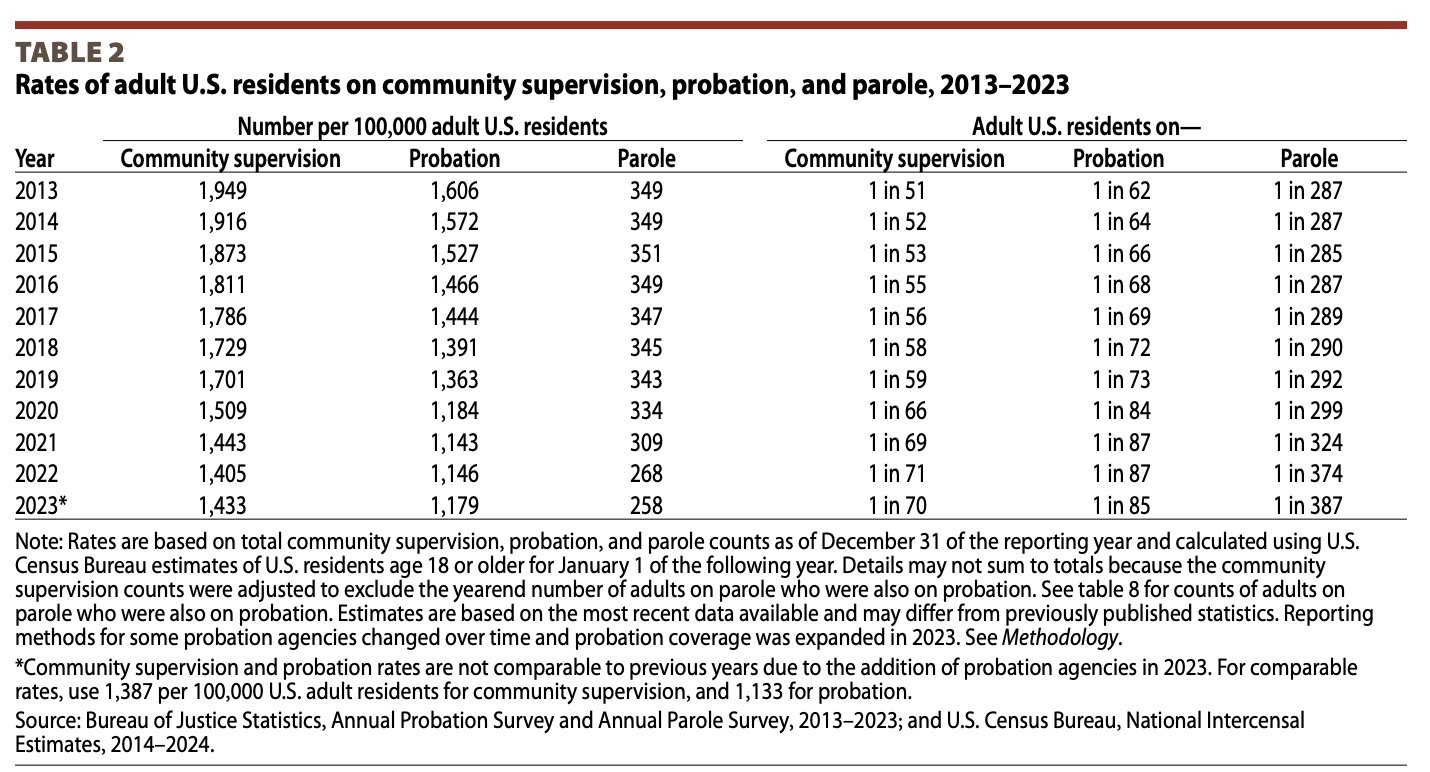
During 2023, 1 in 70 adult U.S. residents or 1,433 per 100,000, were under community supervision.
The parole rate continued to decline, from 268 per 100,000 adult U.S. residents in 2022 to 258 per 100,000 in 2023.
At the end of 2023, 1 in 387 adults in the United States was supervised on parole.
Numbers And Rates On Parole And Probation
As you can see from the charts below, the number of offenders on parole and probation has dropped considerably, from close to 4,750,000 in 2013 to close to 3,800,000 in 2023.
The rate of offenders on parole and probation dropped from close to 2,000 per 100,000 to approximately 1,400 per 100,000.
The rate of parole dropped considerably from close to 350 per 100,000 to approximately 250 per 100,000.
One in 70 US adults was on community supervision in 2023. It was close to one in 50 in 2013. I remember when it was one in 40 during earlier years.
Successful Completions
During 2023, successful completions of probation accounted for 59% of exits among adults whose type of exit was known.
Exits due to incarceration of adults previously under felony probation supervision (21%) during 2023 were more than double that of those under misdemeanor probation (9%) when the type of exit was known.
Sixty-four percent of adults who exited parole during 2023 with a known exit type successfully completed their term of parole.
About 29% of known parole exits were due to incarceration in 2023, up slightly from 2022 (27%).
77 percent of males were on probation for a felony when the characteristics were known.
43 percent of felony probationers were serving time for a violent crime.
66 percent of those on parole were serving time for a violent offense.
For adults on parole supervision in 2023 with a known maximum sentence, 90% were sentenced to more than 1 year of incarceration, thus a felony.
Chart (click to enlarge)
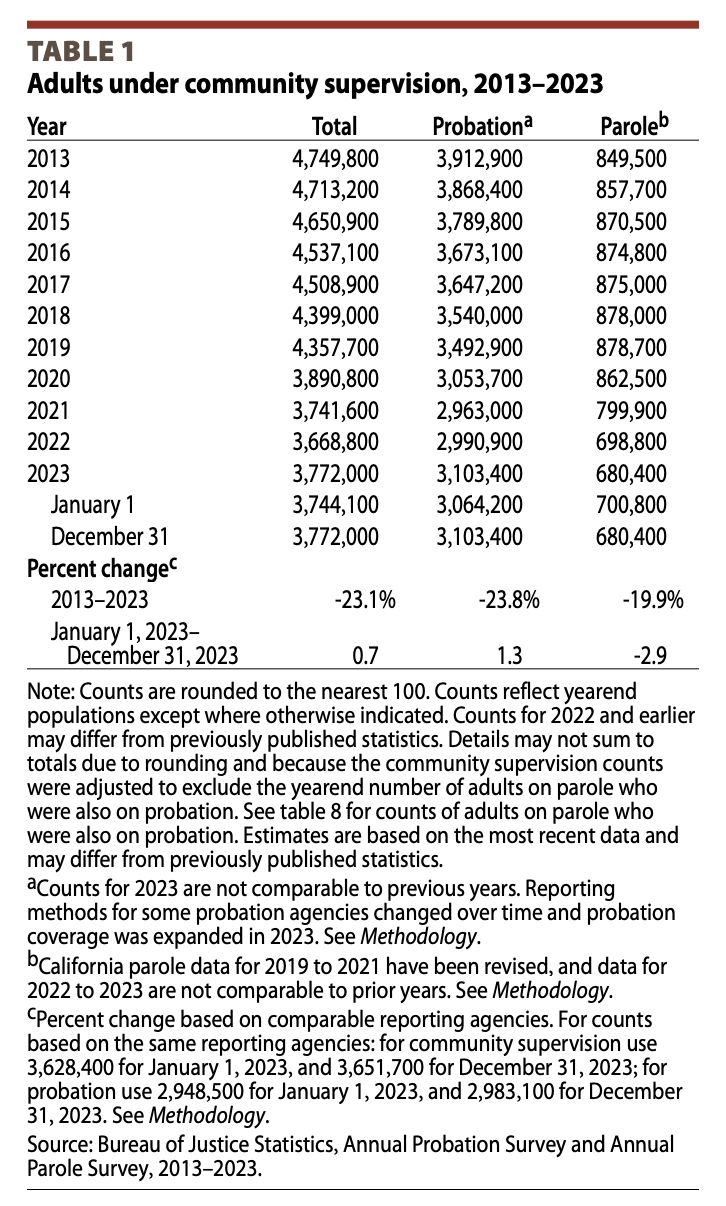
Chart (click to enlarge)