
Summation
There were considerable decreases in violent and property crime in 2024.
In 2024, reported LEOKA assaults ─ which include aggravated and simple assault offenses reached a 10-year high with 85,730 officers assaulted in the line of duty.
Author
Crime in America.Net-“Trusted Crime Data, Made Clear.”
Quoted by The Associated Press, USA Today, A&E Television, the nationally syndicated Armstrong Williams Television Show (30 times), Department of Justice documents, US Supreme Court briefs, C-SPAN, the National Institute of Health, college and university online libraries, multiple books and journal articles, The Huffington Post, JAMA, The National Institute of Corrections, The Office of Juvenile Justice And Delinquency Prevention, The Bureau of Justice Assistance, Gartner Consulting, The Maryland Crime Victims Resource Center, The Marshall Project, The Heritage Foundation via Congressional testimony, Law Enforcement Today, Law Officer.Com, Blue Magazine, Corections.Com, Prison Legal News, The Hill (newspaper of Congress), the Journal of Offender Monitoring, Inside Edition Television, Yomiuri Shimbun (Asia’s largest newspaper), LeFigaro (France’s oldest newspaper), Oxygen and allied publications, Forbes, Newsweek, The Economist, The Toronto Sun, Homeland Security Digital Library, The ABA Journal, The Daily Express (UK) The Harvard Political Review, The Millennial Source, The Federalist Society, Lifewire, The Beccaria Portal On Crime (Europe), The European Journal of Criminology, American Focus and many additional publications.
Sign up for notice of new articles on the front page of this site.
A comprehensive overview of crime for recent years is available at Violent and Property Crime Rates In The U.S.
Article
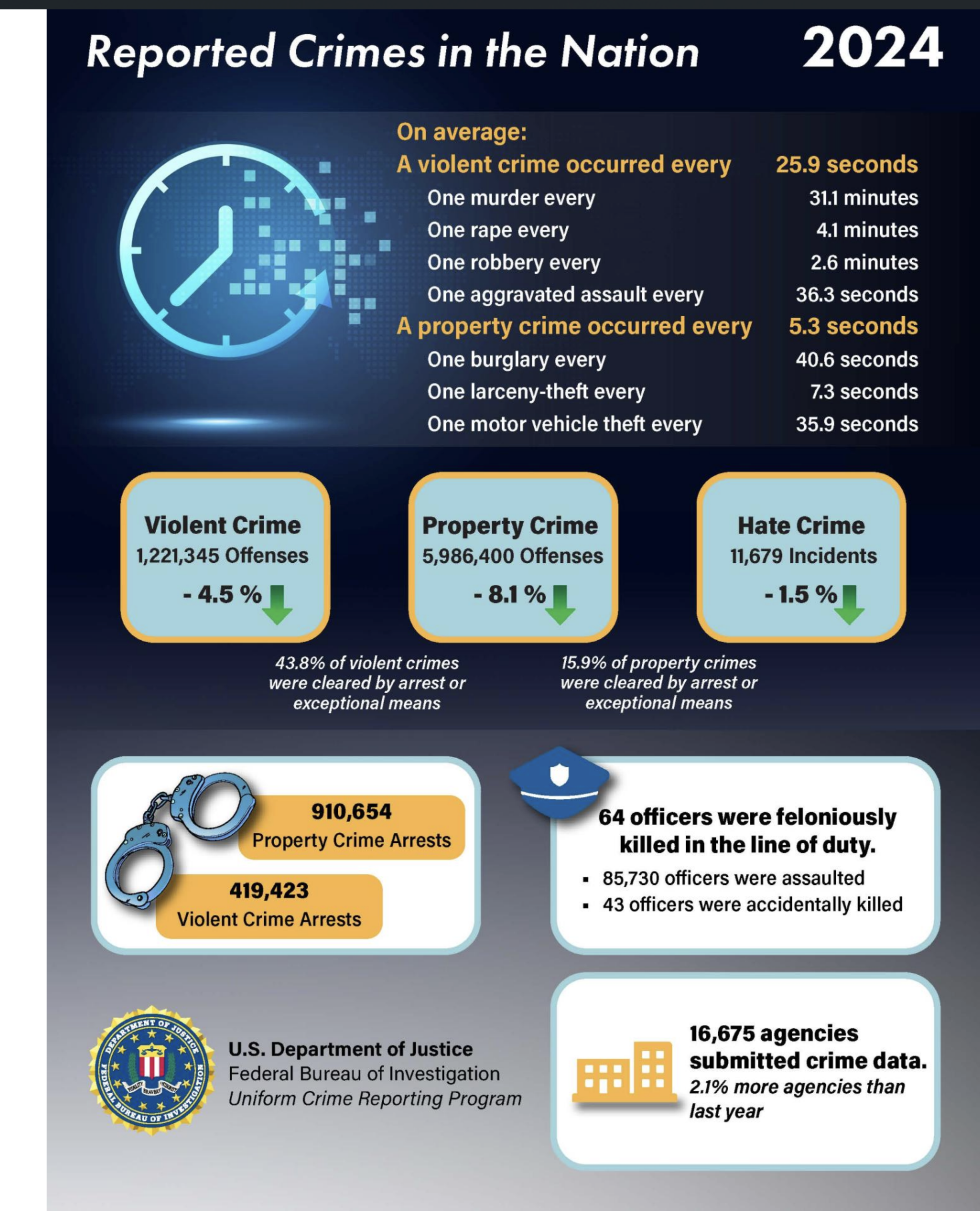
“Reported Crimes in the Nation (RCN), 2024” includes data received from 16,675 law
enforcement agencies that provided data through either the National Incident-Based Reporting System (NIBRS) or the Summary Reporting System (SRS).
These agencies represent 86.3% of agencies actively enrolled in the FBI’s UCR Program and cover a combined population of 325,100,512 (95.6%) inhabitants. Notably, every city agency covering a population of 1,000,000 or more inhabitants contributed a full 12 months of data to the FBI’s UCR Program in 2024.
Estimates based on data submitted by the participating agencies show the following nationwide year-to-year trends:
Violent crime decreased an estimated 4.5% from 2023 to 2024
Property crime decreased an estimated 8.1% from 2023 to 2024
The number of agencies contributing NIBRS data to “RCN, 2024” increased by 562 agencies
compared with the number of agencies that contributed NIBRS data to the previous year’s
“Crime in the Nation, 2023.” In 2024, NIBRS data represented 75.5% of agencies actively
enrolled in the FBI’s UCR Program with a population coverage of 87.2%.
Violent Crime
Violent crime consists of murder and nonnegligent manslaughter, rape, robbery, and aggravated assault. Nationwide, from 2023 to 2024, the estimated volume of violent crime offenses showed the following changes:
Violent crime decreased an estimated 4.5%.
Murder and nonnegligent manslaughter decreased an estimated 14.9%.
Rape decreased an estimated 5.2%.
Robbery decreased an estimated 8.9%.
Aggravated assault decreased an estimated 3.0%.
An estimated 1,221,345 violent crime offenses were committed in 2024, indicating a rate of
359.1 violent crimes per 100,000 inhabitants, down from the 2023 estimated offense rate of
379.5 violent crimes per 100,000 inhabitants.
An estimated 419,423 arrests for violent crime offenses were made in 2024.
In 2024, 35.2% of homicide victims knew their offender(s) (or at least 1 offender when more
than 1 was present) but were not related to them. NIBRS data also showed 16.5% of homicide victims were killed by a stranger, 14.8% by a family member, and 0.8% by a family member and at least 1 other offender who was not related to the victim. About one-third of homicide victims (32.7%) had relationships categorized as “all other,” meaning the victim(s) did not see the offender to determine whether they knew them, was a mutual combatant of the offender, or had a combination of other undefined relationships with multiple offenders.
Property Crime
Property crime consists of burglary, larceny-theft, and motor vehicle theft. Nationwide, from
2023 to 2024, the estimated volume of property crime offenses showed the following changes:
Property crime decreased an estimated 8.1%.
Burglary decreased an estimated 8.6%.
Larceny-theft decreased an estimated 5.5%.
Motor vehicle theft decreased an estimated 18.6%.
An estimated 5,986,400 property crime offenses were committed in 2024, indicating an offense rate of 1,760.1 property crimes per 100,000 inhabitants, down from the 2023 estimated offense rate of 1,934.1 property crimes per 100,000 inhabitants.
An estimated 910,654 arrests for property crime offenses were made in 2024.
Clearances and Arrests
In 2024, law enforcement agencies cleared 43.8% of reported violent crimes by arrest or
exceptional means. In addition, 15.9% of reported property crimes were cleared by arrest or
exceptional means in 2024.
Of the proportion of violent crime offenses cleared by law enforcement in 2024, 8.1% involved solely juvenile offenders under the age of 18. In addition, 7.5% of cleared property crime offenses involved only juvenile offenders during that year.
Crime Trends by Population Group
Crime trends developed from agencies reporting 6 or more common months of data to the FBI’s UCR Program in 2023 and 2024 mostly mirrored the estimated decreases in nationwide violent crime offenses.
Metropolitan county agencies showed the largest decrease (6.5%) in overall
violent crime in 2024. No population group designated within “CIUS, 2024” showed an increase in the year-to-year violent crime trend.
Trends from each population group recorded decreases for all violent crime offenses. City
agencies of 1,000,000 or more inhabitants showed the largest decrease in murder (19.1%).
Agencies of 50,000 to 99,999 showed the largest decrease in robbery offenses (10.5%).
Nonmetropolitan counties showed the largest decrease in rape offenses (9.1%), while
metropolitan counties had the largest decrease (6.3%) in aggravated assault offenses.
Hate Crimes
Considering all reported hate crime data in 2023 and 2024, regardless of the number of months or quarters submitted by law enforcement agencies, the number of hate crime incidents decreased from 11,862 to 11,679, offenses decreased from 13,829 to 13,683, and victims decreased from 14,416 to 14,243. The number of known offenders increased from 9,739 to 10,096.
Law Enforcement Officers Killed and Assaulted (LEOKA)
In 2024, 64 officers were feloniously killed in the line of duty. A total of 61 offenders were
reported in connection with these felonious killings. Firearms were involved in 46 of the 64
felonious deaths. During the same year, 43 officers were accidentally killed while on duty, most of whom died due to motor vehicle-related injuries.
In 2024, reported LEOKA assaults ─ which include aggravated and simple assault offenses reached a 10-year high with 85,730 officers assaulted in the line of duty.
Extended-Year Violent and Property Crime Trends, 2005-2024
FBI data shows 20-calendar-year trends in estimated violent crime rates per 100,000 inhabitants from 2005 to 2024. Rates of murder and nonnegligent manslaughter range from a 20-year low of 4.4 offenses per 100,000 inhabitants in 2014 to a high of 6.7 offenses per 100,000 inhabitants in 2020. Estimated rates during the 3 years from 2020 through 2022 were an average of 6.6 murders per 100,000 inhabitants per year, while the most recent 2024 estimate of 5.0 murders per 100,000 inhabitants returned to a rate closer to the 5.1 murders per 100,000 inhabitants estimated in 2019.
Media Questions
The FBI’s briefing started off with an observation that the name of the report is UCR Summary of Reported Crimes in the Nation, 2024, rather than Crime in the Nation, recognizing that the majority of crime is not reported. See below for reported crime statistics.
According to a briefing from the FBI this morning, the agency will now publish its data every month.
A question was asked about immigrants and crime. The FBI does not include this information.
There was a massive increase in law enforcement officers assaulted. The FBI is conducting a study.
The FBI was asked for insight as to the decrease in crime. The FBI stated that this is a complex question and they declined to offer reasons.
Context
Latest Data On Homicides From The USDOJ and JAMA
- About 38% of violent victimizations in urban areas were reported to police, which was lower than the percentages in suburban (43%) and rural (51%) areas.
- The percentage of rape and sexual assault victimizations in rural areas that were reported to police (52%) was almost four times higher than the share reported to police in urban areas (13%), and almost two times higher than the share reported in suburban areas (29%).
- Reporting to police for simple assault victimizations was higher in suburban (39%) and rural areas (46%) than urban areas (32%).
- For robbery, the percentage of victimizations reported to police was lower in suburban areas (49%) than urban areas (63%). The percentage of robbery victimizations reported to police was not statistically different between urban and rural areas.
Historic data, including data from the National Crime Victimization Survey from the Bureau of Justice Statistics of the US Department of Justice, indicating the largest increase in violent crime in the nation’s history, is available at Violent and Property Crime Rates In The U.S. Multiple categories of crime increased with considerable growth in digital crime and other categories of property crime.
One Reply to “Violent Crime Decreased 4.5 Percent from 2023 to 2024”