

Highlights
This article is available as a YouTube podcast.
“There have to be reasons for declining crime,” states one reader. What about jail and prison statistics? What about arrests? If we put more people in prison, crime goes down, right?
This is the second article using recent criminal justice statistics on why reported crime is declining. The first focused on arrests.
We might be seeing the beginning of small increases in police proactivity. We will have to wait for more data to see if this is a trend. If jail admissions or arrests increased even marginally, it “could” be a sign that police are being more proactive.
Police and correctional authorities may have done a good job of incarcerating high-risk offenders responsible for most crimes, and that may have led to a decrease in reported crime.
Regardless, most in the criminological community will tell you that there are no provable explanations for the current decrease in reported crimes. The same applies to past decreases in crime.
CrimeinAmerica.Net-Chat GPT’s “Top 10 Sources for Crime in America” based on primary statistical sources with trusted secondary analysis.
100 out of a possible 100 score based on website trust, content, and links, Gridinsoft.com.
Crime in America.Net-“Trusted Crime Data, Made Clear.”
Quoted by The Associated Press (multiple times), USA Today, A&E Television, the nationally syndicated Armstrong Williams Television Show (30 times), ABC News, Inside Edition Television, Oxygen and allied publications, Vox, Forbes, Newsweek, The Economist, The Toronto Sun, The Chicago Tribune, The Daily Beast, The Huffington Post, The Baltimore Sun, The Boston Herald, The Capital Gazette, MSN, AOL (multiple times), Yahoo, JAMA, News Break, US News And World Report, The Hill (newspaper of Congress), Department of Justice documents, multiple US Supreme Court briefs, C-SPAN, the National Institute of Health, college and university online libraries, multiple books and journal articles, The National Institute of Corrections, The Office of Juvenile Justice And Delinquency Prevention, The Bureau of Justice Assistance, Gartner Consulting, The Maryland Crime Victims Resource Center, Law.Com, The Marshall Project, The Heritage Foundation via Congressional testimony, Law Enforcement Today, Law Officer.Com, Blue Magazine, Citizens Behind The Badge, Police 1, American Peace Officer, Corections.Com, Prison Legal News, , the Journal of Offender Monitoring, Yomiuri Shimbun (Asia’s largest newspaper), LeFigaro (France’s oldest newspaper), Homeland Security Digital Library, The ABA Journal, The Daily Express (UK) The Harvard Political Review, The Millennial Source, The Federalist Society, Lifewire, The Beccaria Portal On Crime (Europe), The European Journal of Criminology, American Focus and many additional TV stations and publications.
Sign up for notice of new articles on the front page of this site.
A comprehensive overview of crime for recent years is available at Violent and Property Crime Rates In The U.S.
Background-There Have To Be Reasons
“There have to be reasons for declining crime,” states one reader. What about jail or prison statistics? What about arrest data? If we put more people inprison, and hold more people accountable, crime goes down, right?
People are asking if there are statistical reasons ( arrests, jail, prison, or overall corrections data) explaining the decrease in US and urban reported crime. The connection to the article on arrest statistics is available here.
Because jail admissions are mostly arrest-based, this article examines jail statistics in detail and adds overall correctional data.
Background-Reported Crime
I’m using the term reported crime throughout the article to remind readers that the majority of crimes are not reported to law enforcement.
Background-Crime Decreases
Per the FBI, there are decreases in reported crimes ranging from 3 to 4.5 percent for violent crime in 2023 and 2024 (the last full report). Independent analysts state that urban violent crime is dropping like a rock.
Note that the majority of crimes are not reported, and per the US Department of Justice’s National Crime Victimization Survey, it shows big increases (44 percent) in violent crime, including in urban areas.
Article
The weird thing about federal criminal justice statistics is that you can make any claim you want about crime increasing or decreasing based on US Department of Justice data.
Concurrently, you can make any claim you want for the reasons why crime is going up or down using USDOJ or reputable statistics.
And we wonder why people have a hard time understanding crime in the US?
If you believe that reported crime is down (most crimes are not reported), an increase in the jail or prison population might support your claim. If you cite increasing crime via the National Crime Victimization Survey, the loss of 25,000 police officers, fewer arrests, and diminished crimes solved adds credibility to your beliefs.
In this article, we will look at a variety of jail and correctional statistics. Jail admissions can be an indicator of police activity; the great majority of jail admissions are based on arrests.
Why Focus On Jail Statistics?
The charts below give readers a sense of the data in the confined jail population, average population, incarceration rates, and admissions that may serve as a reasonably accurate proxy for national arrest trends.
Everyone arrested is booked, but that doesn’t mean that everyone arrested is jailed. Many arrests result in booking into jail, but most jail stays are brief. Some are there for hours until bail or other pretrial release arrangements are made. See the appendix below for more on the technical aspects of jail operations.
The numbers presented here are from the Bureau of Justice Statistics.
All jail numbers plummeted during the COVID pandemic and have marginally increased through 2024, but with lower numbers compared to earlier years.
Jails reported 7.9 million admissions from July 1, 2023, to June 30, 2024.
Annual jail admissions were reduced by 31 percent from 2014 to 2024.
Annual jail admissions increased by 4.1 percent from 2023 to 2024.
Jail incarceration rates grew from 166 in 2020 to 194 per 100,000 in 2024.
So when considering jail populations, there is marginal growth since the pandemic, but well below earlier numbers.
Charts
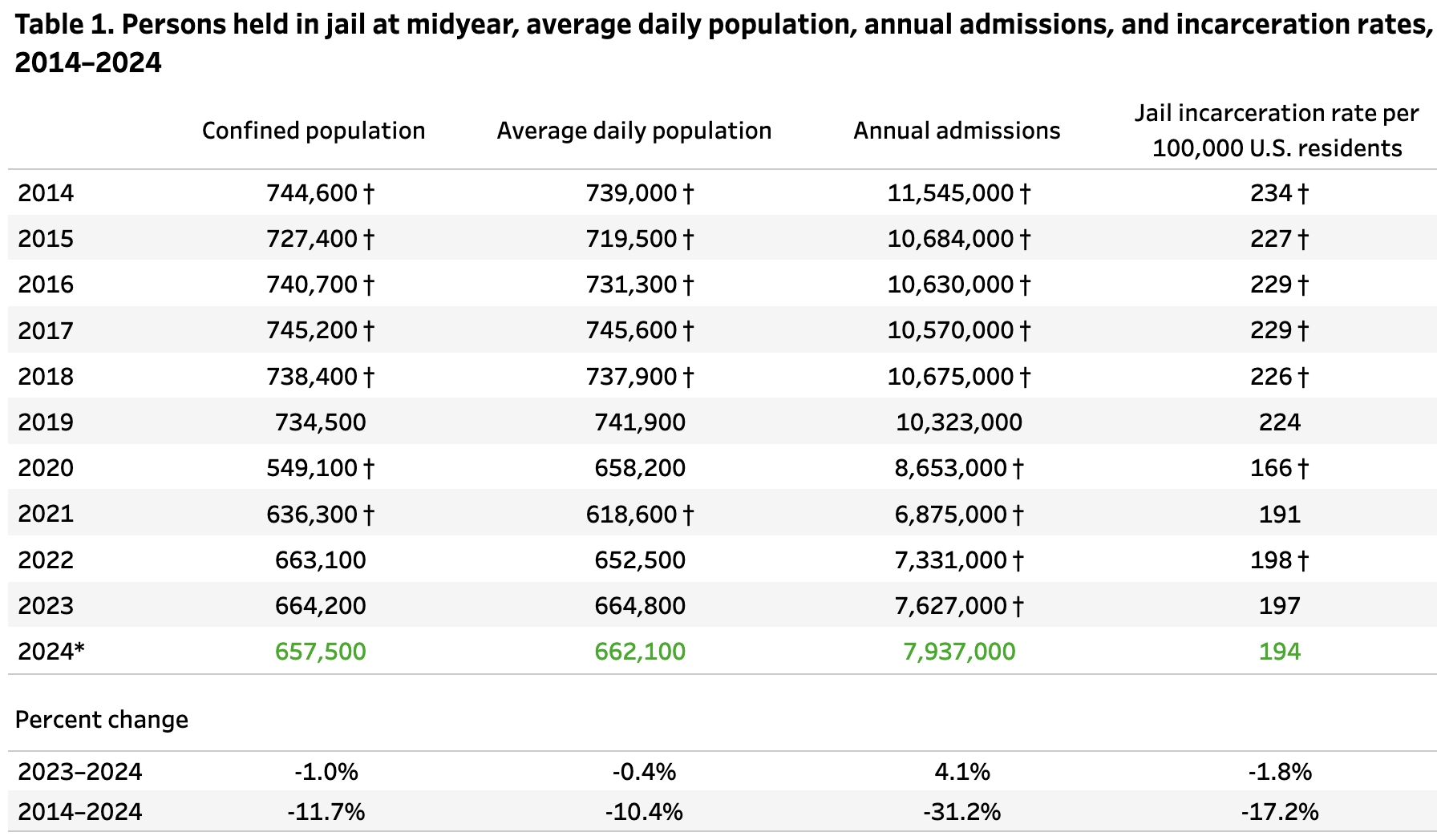
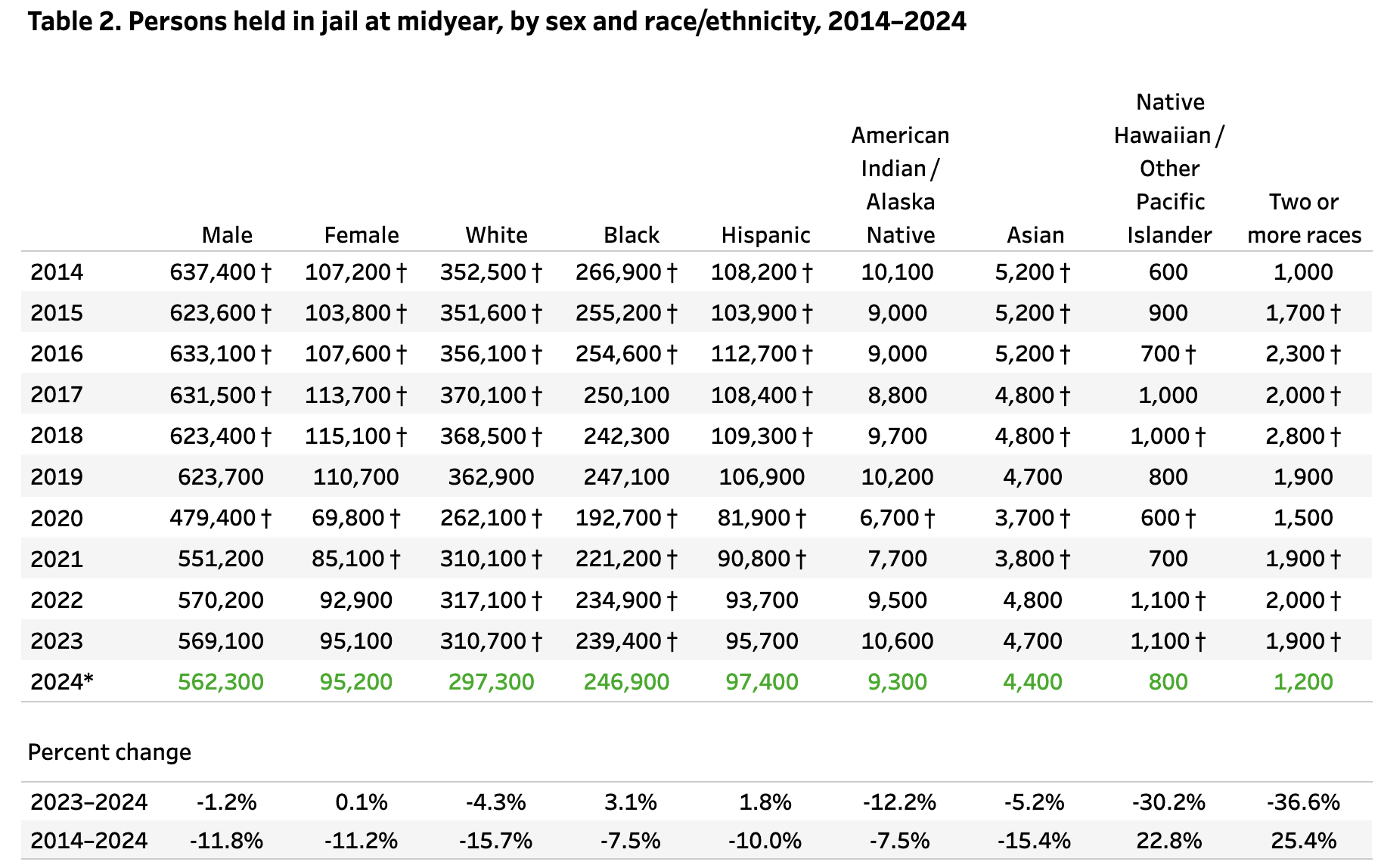
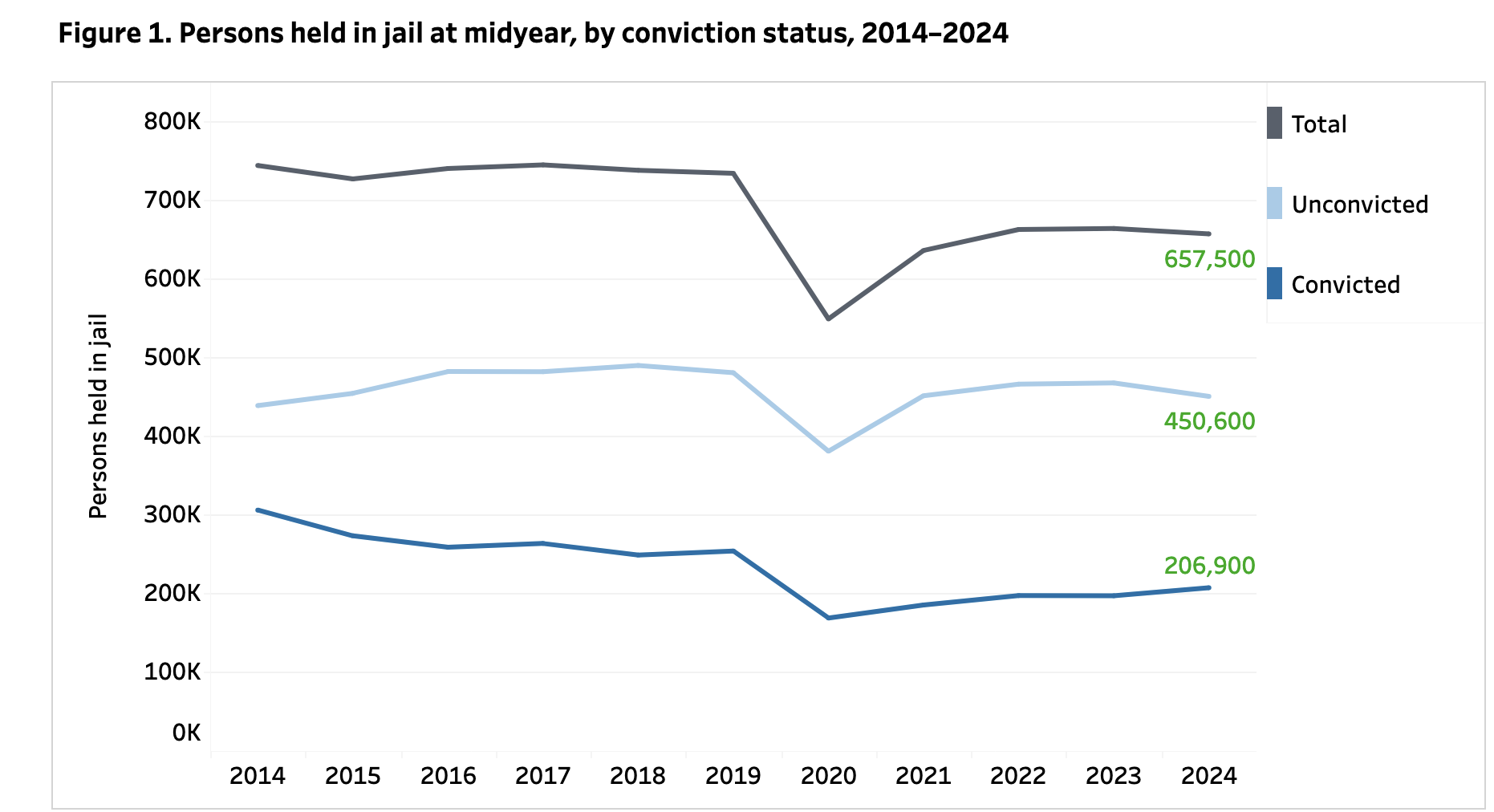
Is a four percent increase in jail admissions and a two percent rise in the US prison population enough to reduce reported crimes? Both represent the latest yearly data presented by the Bureau of Justice Statistics. Arrest data have small increases in two indices out of three.
We might be seeing the beginning of increases in police proactivity. We will have to wait for more data to see if this is a trend.
Prison means that an incarcerated person is no longer free to commit more crimes. If you incarcerate the right people, those responsible for most crimes, public safety is improved. Crime goes down.
Most prison inmates have multiple arrests and incarcerations. The 369,200 persons admitted to state prisons in 34 states had an estimated 4.2 million prior arrests per the Bureau of Justice Statistics. Persons admitted to state prison had a median of nine prior arrests. 78 percent of inmates had previous incarcerations. Forty-two percent had 5-10 or more incarcerations. 62 percent were violent.
Sixty-six percent of male prisoners are violent per BJS. If you include violent histories, the percentage of the violent male prison populations could exceed 80 percent.
We have known for decades that a minority of offenders commit the majority of crimes. However, no one knows exactly what we mean by the terms “minority” and “majority.”
Regardless, “if” you accept that reported crime is decreasing, it’s theoretically possible that police and correctional authorities may have done an acceptable job of incapacitating more high-risk multiple crime offenders, and that may have led to a decrease in reported crime, even if arrests and correctional statistics have decreased during the last ten years or since the pandemic.
Beyond the possibility (however remote) of successfully targeting high-risk offenders, there does not seem to be a clear connection between declining reported crime in recent years and jail–correctional statistics. At the moment, the increases are too small.
The criminological community will repeat what they have said for past crime declines: there is no universal agreement as to why crime declines or increases. We simply do not know with provable certainty. We have endless theories but no proof.
But there is another hurdle to our effort to explain crime rates and totals; crime may not be decreasing.
Data from the National Crime Victimization Survey from the Bureau of Justice Statistics of the US Department of Justice state that rates of violent crime have increased considerably during 2022 (44 percent); and have remained high for 2023 and 2024, thus, based on BJS data, the original suggestion of jail admissions or arrests contributing to reduced reported crime (BJS also states that violence increased in urban areas) is not substantiated.
Thus, if your point is that violent crimes have increased, fewer police officers, lower arrests, marginal correctional numbers, and crimes cleared over time might make sense.
Appendix-More On Jails
Increases in jail admissions might be based on fewer people being released on bail or pretrial status.
There is no official national statistic that states exactly what percentage of arrests result in jail admissions. However, jail admissions data show about 7–8 million admissions per year, similar in scale to national arrest totals. This implies that a substantial majority of arrests that involve physical custody do result in jail admissions, although some arrests lead to citations and release without booking.
Jail admissions count each entry into custody, not unique individuals. A person arrested and later returned to jail to serve a sentence would be counted twice — once for each booking. BJS jail population counts, however, measure the number of people in custody at a specific time and do not double-count individuals whose legal status changes while incarcerated.
ChatGPT
Privacy Policy
We do not collect your personal information. See our privacy policy at “About This Site.”
See More
See more articles on crime and justice at Crime in America.
Most Dangerous Cities/States/Countries at Most Dangerous Cities.
US Crime Rates at Nationwide Crime Rates.
National Offender Recidivism Rates at Offender Recidivism.
The Crime in America.Net RSS feed (https://crimeinamerica.net/?feed=rss2) provides subscribers with a means to stay informed about the latest news, publications, and other announcements from the site.