
Highlights
Quoted by The Associated Press (multiple times), USA Today, Axios, A&E Television, the nationally syndicated Armstrong Williams Television Show (35 times), ABC News, Inside Edition Television, Oxygen and allied publications, Vox, Forbes, Newsweek, The Economist, The Toronto Sun, The Chicago Tribune, The Daily Beast, The Huffington Post, The Baltimore Sun, The Boston Herald, The Capital Gazette, MSN, AOL (multiple times), Yahoo (multiple times), Yahoo Canada, Yahoo New Zealand, JAMA, News Break, US News And World Report, The Hill (newspaper of Congress), NewsMax, Department of Justice documents, multiple US Supreme Court briefs, C-SPAN, the National Institute of Health, college and university online libraries, multiple books and journal articles, The National Institute of Corrections, The Office of Juvenile Justice And Delinquency Prevention, The Bureau of Justice Assistance, Gartner Consulting, The Maryland Crime Victims Resource Center, Law.Com, The Marshall Project, The Heritage Foundation via Congressional testimony, Law Enforcement Today, Law Officer.Com, Blue Magazine, Citizens Behind The Badge, Police 1, American Peace Officer, Corections.Com, Prison Legal News, the Journal of Offender Monitoring, Yomiuri Shimbun (Asia’s largest newspaper), LeFigaro (France’s oldest newspaper), Homeland Security Digital Library, The ABA Journal, The Daily Express (UK), The Independant (UK), The Seoul Economic Daily (Korea), The Albanian Post, The Harvard Political Review, The Millennial Source, The Federalist Society, Lifewire, The Beccaria Portal On Crime (Europe), The European Journal of Criminology, American Focus and many additional TV stations and publications.
Sign up to receive notifications about new articles on the front page of this site.
A comprehensive overview of crime for recent years is available at Violent and Property Crime Rates In The U.S.
Note
The US Bureau of Labor Statistics counts police officers “and” civilians working for police agencies in jobs ranging from crime scene technicians to spokespeople to IT and fingerprint and crime analysis specialists to an array of jobs where arrest powers are not necessary. All are vital to the proper functioning of law enforcement agencies.
USDOJ’s Bureau of Justice Statistics data indicate that civilians account for about one-fifth of full-time personnel in local police departments, although that percentage should not be assumed to apply precisely to the BLS employment series. BLS data does not establish a percentage of civilians in police employment
Analysis
In January 2025, I wrote The United States Lost Over 25,000 Local Police Personnel.
Highlights from that article:
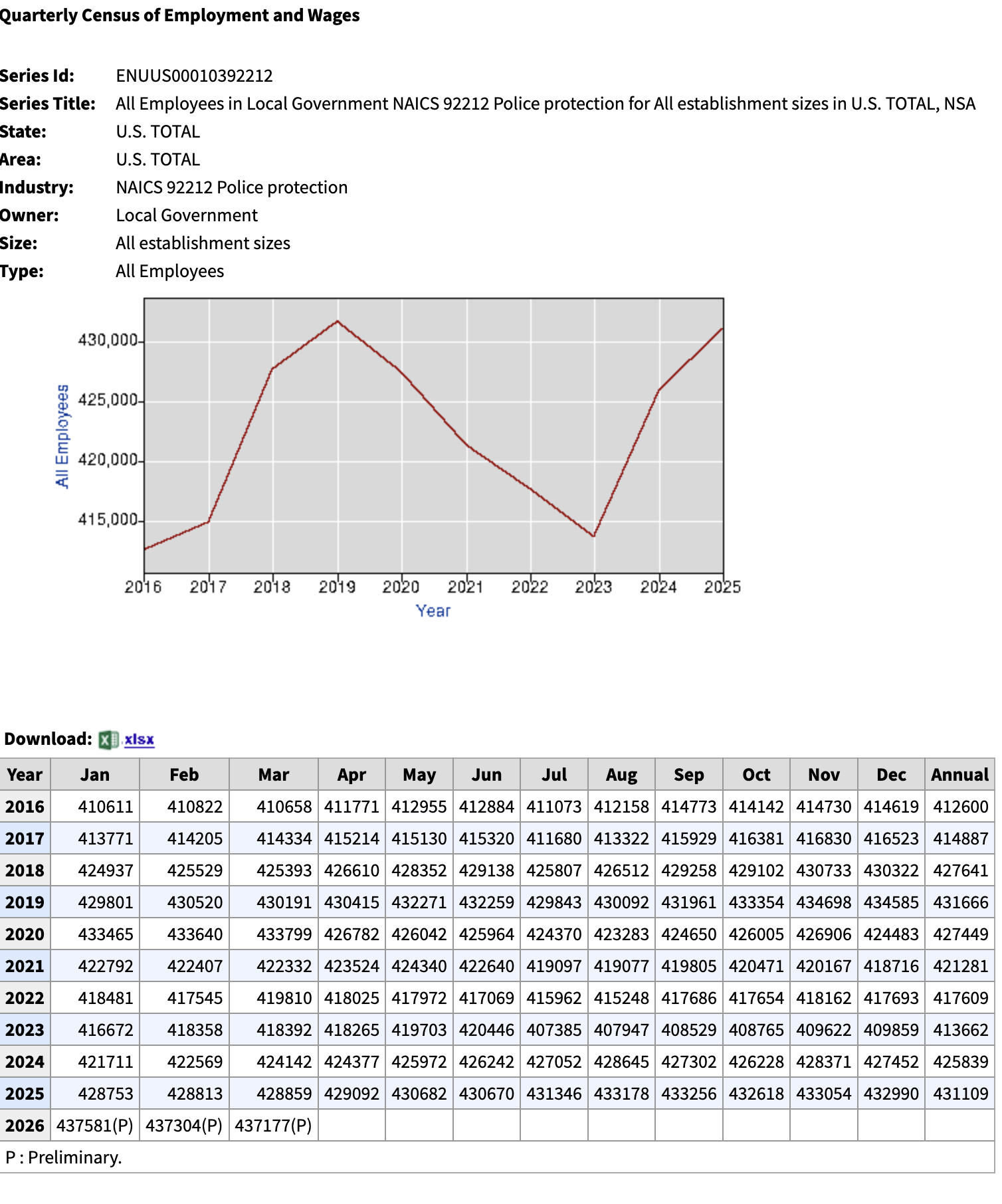
Per the Bureau of Labor Statistics, the United States lost 25,076 local government police personnel, comparing a high of 434,698 in November 2019 to 409,662 in November 2023.
Per the Bureau of Labor Statistics, the United States lost 18,004 local government police personnel from the calendar year 2019 (431,666) to 413,662 in 2023.
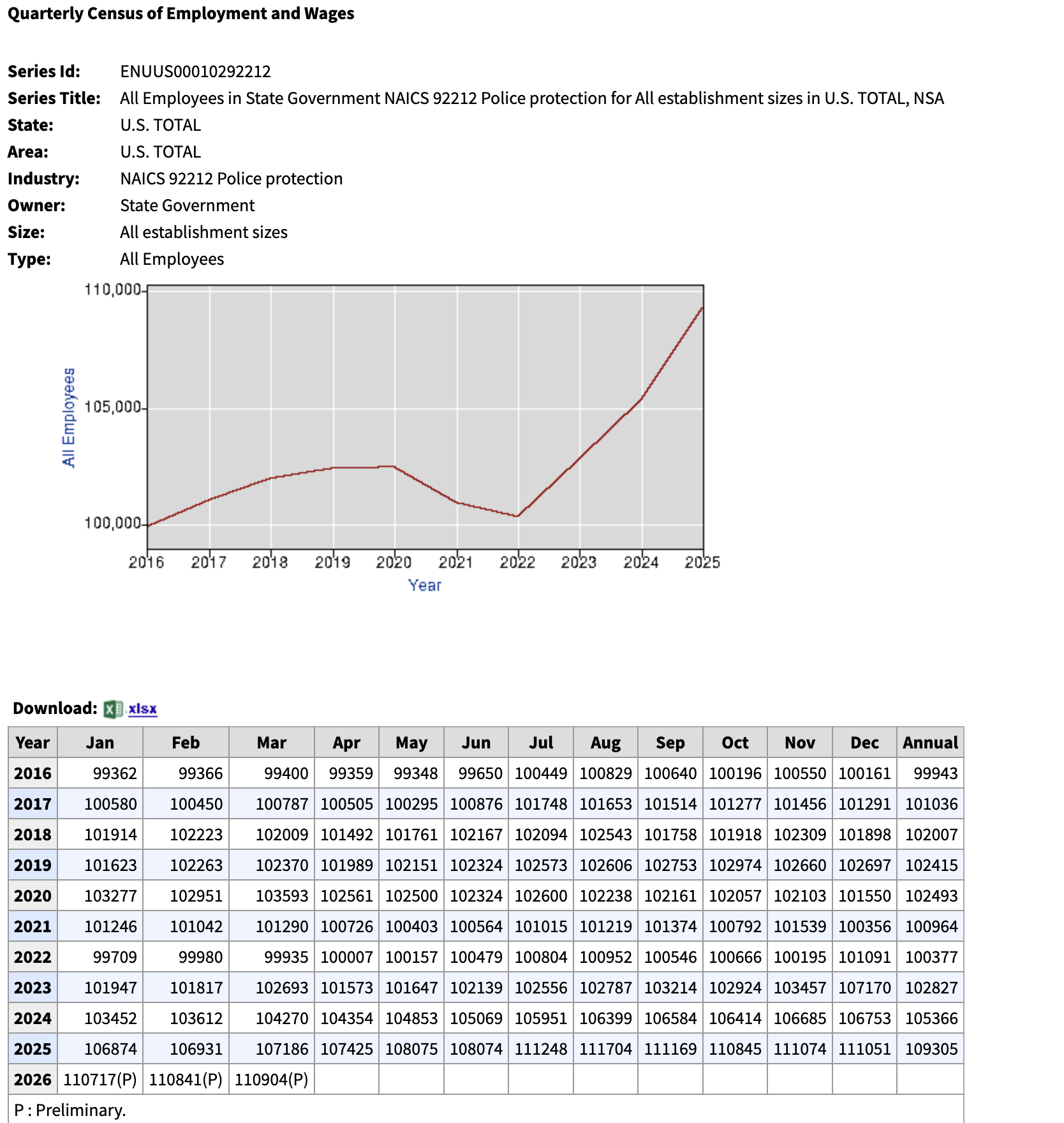
Per the Bureau of Labor Statistics, the United States lost 2,116 state government police personnel from the calendar year 2020 (102,493) to 100,377 in 2022.
The good news is that, per preliminary data from the Bureau of Labor Statistics, the most recent figure, for June of 2024, shows local government police personnel rebounded to 426,210.
That rebound continues below.
Why Did We Lose 25,000 Cops And Support Staff?
There was a steady decrease in police hiring and retention from 2019 to 2023.
A comprehensive study analyzing public demonstrations against the police use of force across the 170 largest U.S. cities from 2000 to 2019 cataloged thousands of local street protests. One may presume that the negative publicity had an impact on recruitment, retirement, or veteran police officers leaving the force.
It is reasonable to ask whether the unusually negative public environment surrounding policing contributed to the employment decline.
Many in law enforcement strongly objected to the stereotype of all or most police officers employing unnecessary violence when those cases involved a small number of police personnel. There were numerous media articles suggesting that American law enforcement had a violence problem specifically directed towards minority groups.
Repeated research from the USDOJ interviewing people interacting with law enforcement consistently stated that the use “or” the threat of force averaged two percent of police-civilian encounters. That’s hardly a case for the accusations of unnecessary violence in media accounts.
City-reported crime rose significantly during the 2019-2023 period (see conclusions—a 50 percent increase in urban homicides). There were endless complaints from communities that it took over an hour for officers to arrive at crime scenes, or they did not see officers patrolling their communities. Police chiefs and mayors stated that the loss of personnel hampered basic operations.
Current Local Police Employment Statistics From The Bureau of Labor Statistics
Per the latest data from the Bureau of Labor Statistics, from the turnaround in 2023 to annual employment in 2025, we gained 17,447 local police personnel.
Per the latest data from the Bureau of Labor Statistics, from the annual low point in 2022 to annual employment in 2025, we gained 17,609 local police personnel.
Per the preliminary data from the Bureau of Labor Statistics in March 2026, compared to annual figures for 2023, we gained 23,455 local police personnel.
BLS Chart-Local Government
The pattern for the return to police employment for state law enforcement personnel started in 2022 rather than 2023 for local police hiring.
BLS Chart-State Government
For state law enforcement, from an annual low point in 2022 to 2025, we gained 8,928 personnel.
For state law enforcement, from an annual low point to preliminary data in March of 2026, we gained 19,527 personnel
Conclusions-Opinions
Some will claim that I’m politicizing this article with the following statement, but many believe that our national leaders set the tone for occupational hiring. President and candidate Donald Trump’s statements regarding police generally focused on expanding law enforcement powers, providing full immunity, and strongly condemning anti-police rhetoric. He frequently calls himself a champion of “law and order” and advocates for fewer restrictions on how officers handle suspects.
Did the President’s statements encourage the turnaround in police hiring and retention? If not, what did?
Per the Major Cities Chiefs Association for 2022, compared to 2019 midyear figures, cities experienced a 50% increase in homicides and a roughly 36% increase in aggravated assaults. Current reported crime data indicates stark decreases in most forms of crime.
Did more cops reverse this trend? There are reports from cities that solved crimes are increasing.
Why the increase in police employment?
The Bureau of Labor Statistics does not infer reasons for police employment losses or gains. Market forces may have played a role. Perhaps police officers and agencies benefited from stronger political and public support for the profession.
But after the media bashing of the profession after use-of-force incidents before 2019, suggesting that the profession was either violent or racist, having supportive statements from the White House didn’t hurt. 2019 is when local police hiring and retention plummeted.
Did a return to hiring and retention contribute to lower reported crime? Reported crime started to decrease concurrent with the return to police hiring in 2023-2026.
Correlations do not equal causation, but if the additional police officers returned to proactive policing, one of the few modalities where research states it reduces crime (per the National Academies of Sciences review of over 1,000 studies), it’s possible that more cops may have led to reduced reported crime.
Other indicators suggest that things may be changing due to increased arrests and slightly more people going to jail or prison, per the Bureau of Justice Statistics. Just note that arrests and crimes solved plummeted in past years; it was probable that there would be increases or, per researchers, a regression or return to the mean (or average).
Whatever all this means, it’s understood that we cannot judge an entire profession based on the misdeeds of a few.
Medical errors have recently been recognized as a serious public health problem, reported as the third leading cause of death in the US. One NIH study reported that approximately 400,000 hospitalized patients experience some preventable harm each year, while another estimated that 200,000 patient deaths annually were due to preventable medical errors.
Based on this, are we going to stereotype the entire medical profession? Based on reporting mistakes, are we going to condemn all journalists?
Yes, policing needs to improve. Yes, police officers need to be accountable. However, stereotyping the police profession is counterproductive to the public’s safety. Maybe cops needed cheerleaders to aid recruitment and retention. Maybe cops needed encouragement or permission to return to proactive policing.
Per Gallup, confidence in American Police Exceeds Most Other Institutions. Law enforcement is respected and trusted more than most professions.
Maybe it took a variety of factors to recruit and retain more police officers and allow them to return to effective policing.
Privacy Policy
We do not collect your personal information. See our privacy policy at “About This Site.”
See More
See more articles on crime and justice at Crime in America.
Most Dangerous Cities/States/Countries at Most Dangerous Cities.
US Crime Rates at Nationwide Crime Rates.
National Offender Recidivism Rates at Offender Recidivism.
The Crime in America.Net RSS feed (https://crimeinamerica.net/?feed=rss2) provides subscribers with a means to stay informed about the latest news, publications, and other announcements from the site.