
Highlights
Latest national jail statistics from the Bureau of Justice Statistics (BJS) of the USDOJ.
Are more people being held in jail before their trial date?
More arrested defendants are being held in jail on a pretrial basis. The most defensible conclusion is that unconvicted people account for a larger share of jail inmates than they did a decade ago.
Advocates want most defendants released before trial.
Most in law enforcement believe that the emphasis should be on public safety, not pretrial release based on the severity of the crime and criminal history.
There are increased numbers of charged older offenders, juvenile offenders being charged as adults, and parole and probation violators. Felony holds remained stable.
Quoted by The Associated Press (multiple times), USA Today, Axios, A&E Television, the nationally syndicated Armstrong Williams Television Show (35 times), ABC News, Inside Edition Television, Oxygen and allied publications, Vox, Forbes, Newsweek, The Economist, The Toronto Sun, The Chicago Tribune, The Daily Beast, The Huffington Post, The Baltimore Sun, The Boston Herald, The Capital Gazette, MSN, AOL (multiple times), Yahoo (multiple times), Yahoo Canada, Yahoo New Zealand, JAMA, News Break, US News And World Report, The Hill (newspaper of Congress), NewsMax, Department of Justice documents, multiple US Supreme Court briefs, C-SPAN, the National Institute of Health, college and university online libraries, multiple books and journal articles, The National Institute of Corrections, The Office of Juvenile Justice And Delinquency Prevention, The Bureau of Justice Assistance, Gartner Consulting, The Maryland Crime Victims Resource Center, Law.Com, The Marshall Project, The Heritage Foundation via Congressional testimony, Law Enforcement Today, Law Officer.Com, Blue Magazine, Citizens Behind The Badge, Police 1, American Peace Officer, Corections.Com, Prison Legal News, the Journal of Offender Monitoring, Yomiuri Shimbun (Asia’s largest newspaper), LeFigaro (France’s oldest newspaper), Homeland Security Digital Library, The ABA Journal, The Daily Express (UK), The Independant (UK), The Seoul Economic Daily (Korea), The Albanian Post, The Harvard Political Review, The Millennial Source, The Federalist Society, Lifewire, The Beccaria Portal On Crime (Europe), The European Journal of Criminology, American Focus and many additional TV stations and publications.
Sign up to receive notifications about new articles on the front page of this site.
A comprehensive overview of crime for recent years is available at Violent and Property Crime Rates In The U.S.
Note
I combine Bureau of Justice Statistics data with my own observations to put federal data into context.
BJS data alone do not answer most readers’ questions about increases or decreases in pretrial detainees.
Analysis
When I was the director of public information for the Maryland Department of Public Safety (a police and corrections operation), the state-run Baltimore City Jail was overflowing, overcrowded, and almost impossible to manage.
I took an editorial writer from a major newspaper inside a massively overcrowded dormitory; he was frightened by what he saw, and he wanted out ASAP. This was typical of urban jails at the time due to aggressive policing.
The national status of jails has changed considerably since then, with only 10.9 percent of today’s jails operating at overcapacity. 72% of jail beds were occupied in 2024.
Pretrial Release—What Advocates Believe
For the last decade, releasing people arrested on no bail or personal recognizance has generated its fair share of controversy. Pretrial-release advocates argue that defendants should not be detained solely because they cannot afford financial bail and that courts should use the least restrictive conditions necessary to assure appearance at trial.
Advocates correctly believe that the arrested person is not guilty of a charge until a verdict or sentence is reached.
They suggest that pretrial release saves taxpayers a considerable amount of money and that the vast majority of those charged with crimes would appear in court.
Active Supervision
I am unaware of the percentage of pretrial defendants who are under active supervision of a pretrial supervision agency. I’m guessing that many, if not most jurisdictions do not have a pretrial supervision function that mimics larger urban agencies. In essence, those arrested and waiting for trials are essentially unsupervised.
Interestingly, BJS reports that local jails supervised 43,600 people outside jail in programs including electronic monitoring, home detention, day reporting, community service, treatment, and other pretrial supervision/work programs in 2024.
Generally speaking, the arrested person is held in jail if he is a flight risk or a danger to society. People may also remain in jail because they cannot satisfy financial bail, are subject to warrants or detainers, are held for probation or parole violations, or are detained under other legal authority.
It’s my understanding that most jurisdictions put a greater emphasis on flight risk; the probability of appearance in court. You could literally have multiple arrests and incarcerations and still be released before trial on a new criminal charge.
A study from the Bureau of Justice Statistics (Felony Defendants in Large Urban Counties) in 2009 suggests that financial conditions (i.e., bail) accounted for 61 percent of pretrial releases, but that was before the movement to reduce or eliminate cash bail. That’s the latest data on the use of monetary bail.
Law Enforcement Encourages Pretrial Incarceration
There are many within law enforcement who see the need to keep a person in jail until trial for an endless number of reasons beyond his flight risk or his probability of appearing for trial. When I was a police officer, I wanted those I arrested for crimes of violence to be held in jail until trial.
Imagine a person charged with an act of violence and the fear he creates for victims by returning home to his community within hours of his arrest, considering that the majority of violent crime occurs between people who know each other and may live close by. The impact on his victims would be considerable, especially if the case involves domestic violence, which it frequently does.
The Essential Question
So with all of this controversy, are more people being held in jail before their trial date?
Data From The Bureau of Justice Statistics
Jail Inmates in 2024 – Statistical Tables provides the latest data on the Nation’s jails. It was published in September of 2026.
What the Bureau Of Justice Statistics Says About The Use Of Pretrial Incarceration
At midyear 2024, 68 percent of jail inmates were unconvicted (meaning they were awaiting court action on a current charge or were being held for other reasons).
This is down from a peak of 71 percent in 2021 but up from 59 percent at midyear 2014.
From 2023 to 2024, the number of unconvicted persons decreased 3.6%, from 467,600 to 450,700, marking the first year-to-year decline since 2020.
Thus, the use of pretrial incarceration based upon a percentage of those who were unconvicted shows growth since 2014, but the numbers declined slightly from 2023 to 2024.
The figures support the conclusion that unconvicted people make up a larger share of jail inmates than in 2014. They do not, on their own, establish that courts have become more likely to detain defendants.
The most defensible conclusion is that unconvicted people account for a larger share of jail inmates than they did a decade ago.
Context
A larger share of local jail inmates is unconvicted than a decade ago. The reasons for this change cannot be established from BJS statistics alone.
Crimes reported to law enforcement declined during this period (2021-2024), which may have affected numbers.
National arrest rates declined steadily. Since 2020, arrests for both adults and juveniles have remained far below their historical peaks and below 2019 levels.
The FBI reports that arrests decreased slightly in 2024 before increasing in 2025.
So, with reported crimes and arrests declining in 2024, 68 percent of jail inmates were unconvicted in 2024 versus 59 percent in 2014, indicating a possible willingness to keep more people incarcerated before trial over time.
The Rest of The Bureau Of Justice Statistics Report
BJS does not provide explanations for any increases or decreases in their report. Interpretations are my own.
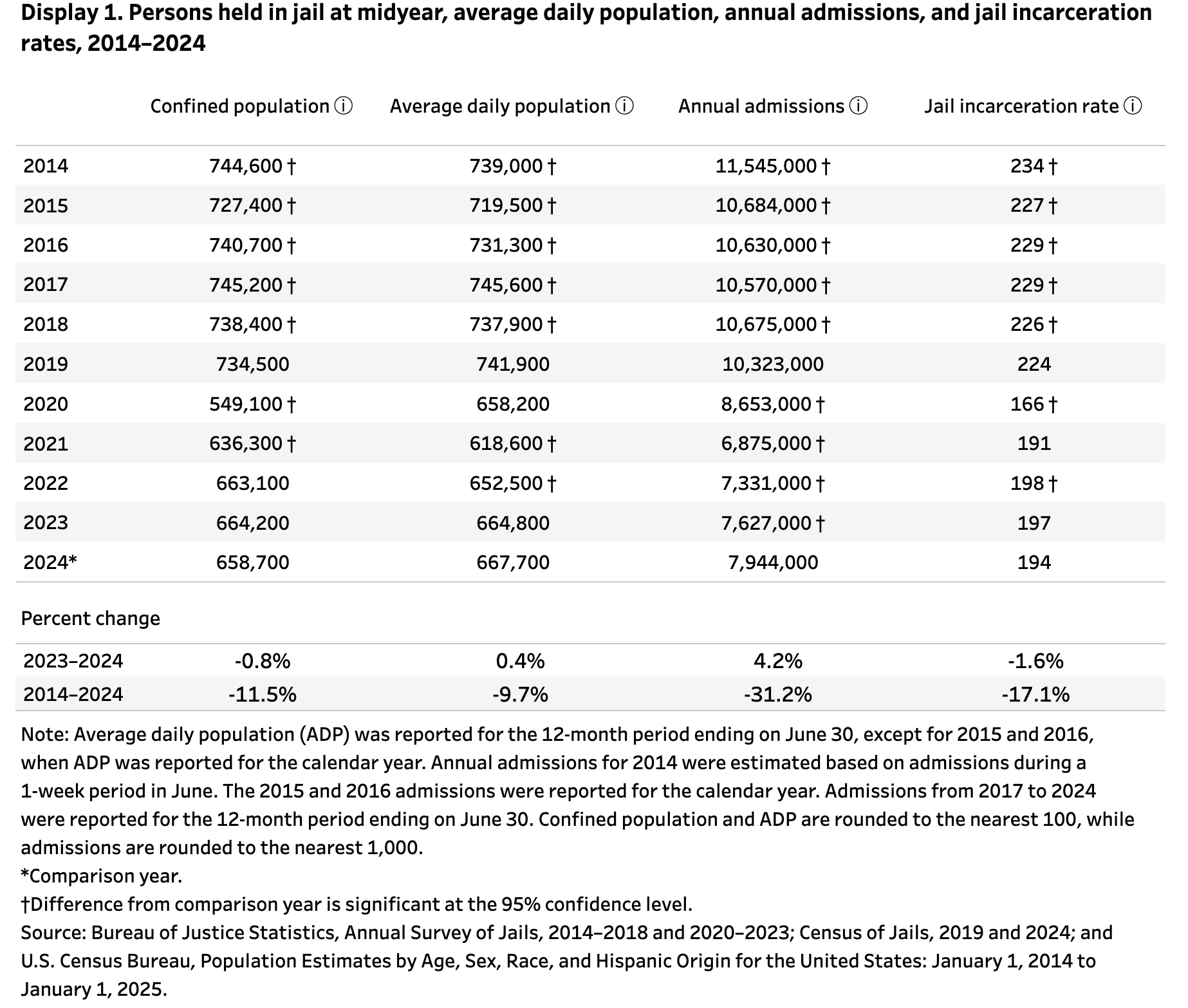
From July 2023 through June 2024, local jails nationwide reported 7.9 million admissions, 4% higher than the 7.6 million in 2023 but 31% lower than the 11.5 million admissions in 2014.
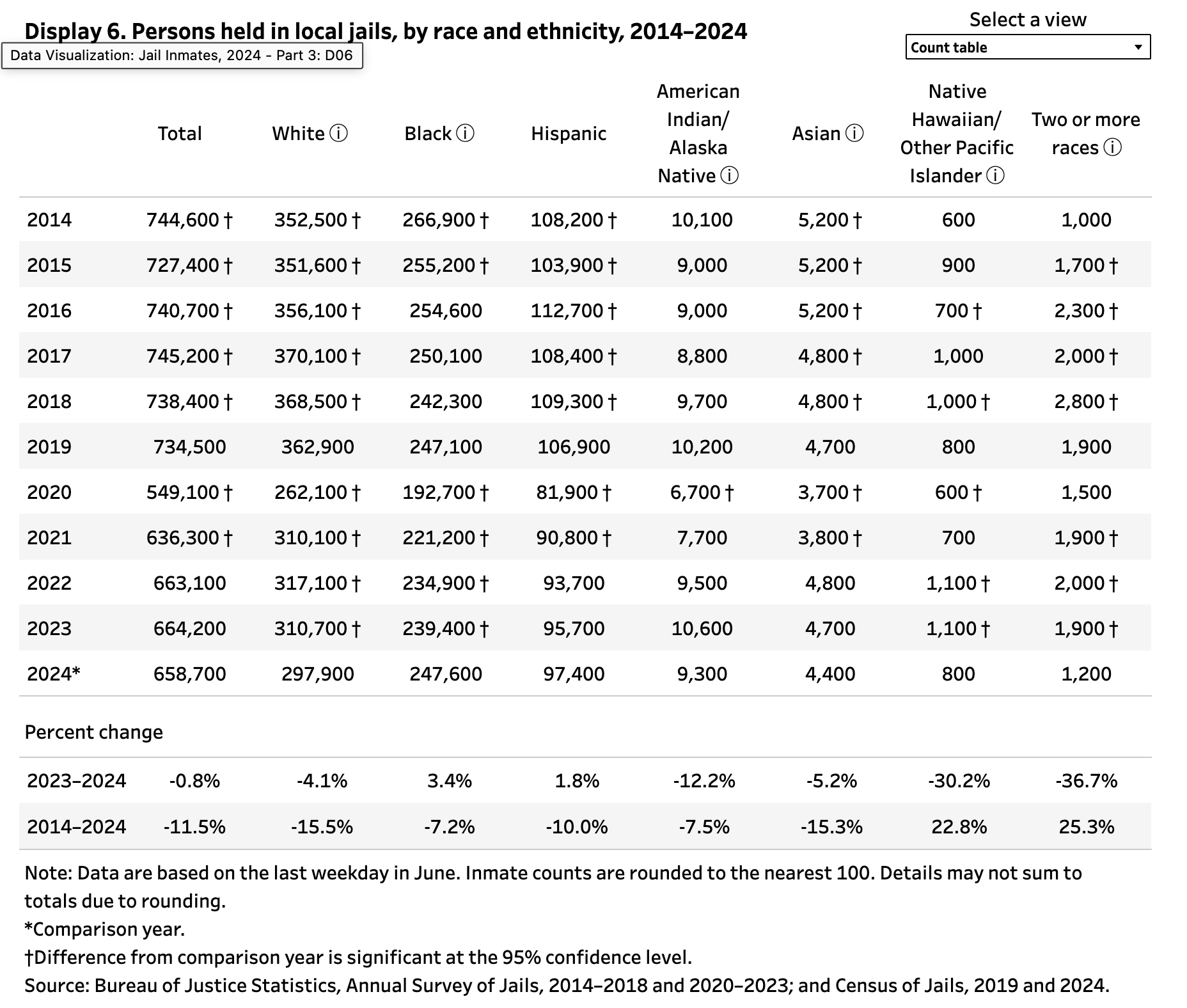
At midyear 2024, local jails held 658,700 persons in custody, similar to midyear 2023 (664,200) but a 12% decrease from the inmate population in 2014 (744,600).
The jail incarceration rate was 194 per 100,000 U.S. residents in 2024, down 17% from 234 inmates per 100,000 in 2014.
The average daily population of jails (ADP) was 667,700 persons during this period, increasing slightly but nearly unchanged from 2023 (664,800). It was down 10% from 2014 (739,000).
About This Report
Findings in this report are based on the 2014–2018 and 2020–2023 Annual Survey of Jails (ASJ) and the 2019 and 2024 Census of Jails (COJ). Inmate population counts are based on the last weekday in June (midyear).
In December 2025, BJS published Preliminary Data Release — Jails (2024). This web report provides an update to the preliminary release.
ChatGPT
ChatGPT fact-checked this article.
Privacy Policy
We do not collect your personal information. See our privacy policy at “About This Site.”
See More
See more articles on crime and justice at Crime in America.
Most Dangerous Cities/States/Countries at Most Dangerous Cities.
US Crime Rates at Nationwide Crime Rates.
National Offender Recidivism Rates at Offender Recidivism.
The Crime in America.Net RSS feed (https://crimeinamerica.net/?feed=rss2) provides subscribers with a means to stay informed about the latest news, publications, and other announcements from the site.