

Notes
This article is based on a document from the Bureau of Justice Statistics of the US Department of Justice using crimes reported to law enforcement via the FBI’s National Incident-Based Reporting System.
The document includes a state-by-state breakdown of homicides for 2025.
The title is Homicide Victimization in the United States, 2025
CrimeinAmerica.Net-Chat GPT’s “Top 10 Sources for Crime in America” based on primary statistical sources with trusted secondary analysis.
Quoted by The Associated Press (multiple times), USA Today, Axios, A&E Television, the nationally syndicated Armstrong Williams Television Show (35 times), ABC News, Inside Edition Television, Oxygen and allied publications, Vox, Forbes, Newsweek, The Economist, The Toronto Sun, The Chicago Tribune, The Daily Beast, The Huffington Post, The Baltimore Sun, The Boston Herald, The Capital Gazette, MSN, AOL (multiple times), Yahoo (multiple times), Yahoo Canada, Yahoo New Zealand, JAMA, News Break, US News And World Report, The Hill (newspaper of Congress), NewsMax, Department of Justice documents, multiple US Supreme Court briefs, C-SPAN, the National Institute of Health, college and university online libraries, multiple books and journal articles, The National Institute of Corrections, The Office of Juvenile Justice And Delinquency Prevention, The Bureau of Justice Assistance, Gartner Consulting, The Maryland Crime Victims Resource Center, Law.Com, The Marshall Project, The Heritage Foundation via Congressional testimony, Law Enforcement Today, Law Officer.Com, Blue Magazine, Citizens Behind The Badge, Police 1, American Peace Officer, Corections.Com, Prison Legal News, the Journal of Offender Monitoring, Yomiuri Shimbun (Asia’s largest newspaper), LeFigaro (France’s oldest newspaper), Homeland Security Digital Library, The ABA Journal, The Daily Express (UK), The Independant (UK), The Seoul Economic Daily (Korea), The Albanian Post, The Harvard Political Review, The Millennial Source, The Federalist Society, Lifewire, The Beccaria Portal On Crime (Europe), The European Journal of Criminology, American Focus and many additional TV stations and publications.
Sign up to receive notifications about new articles on the front page of this site.
A comprehensive overview of crime for recent years is available at Violent and Property Crime Rates In The U.S.
Article
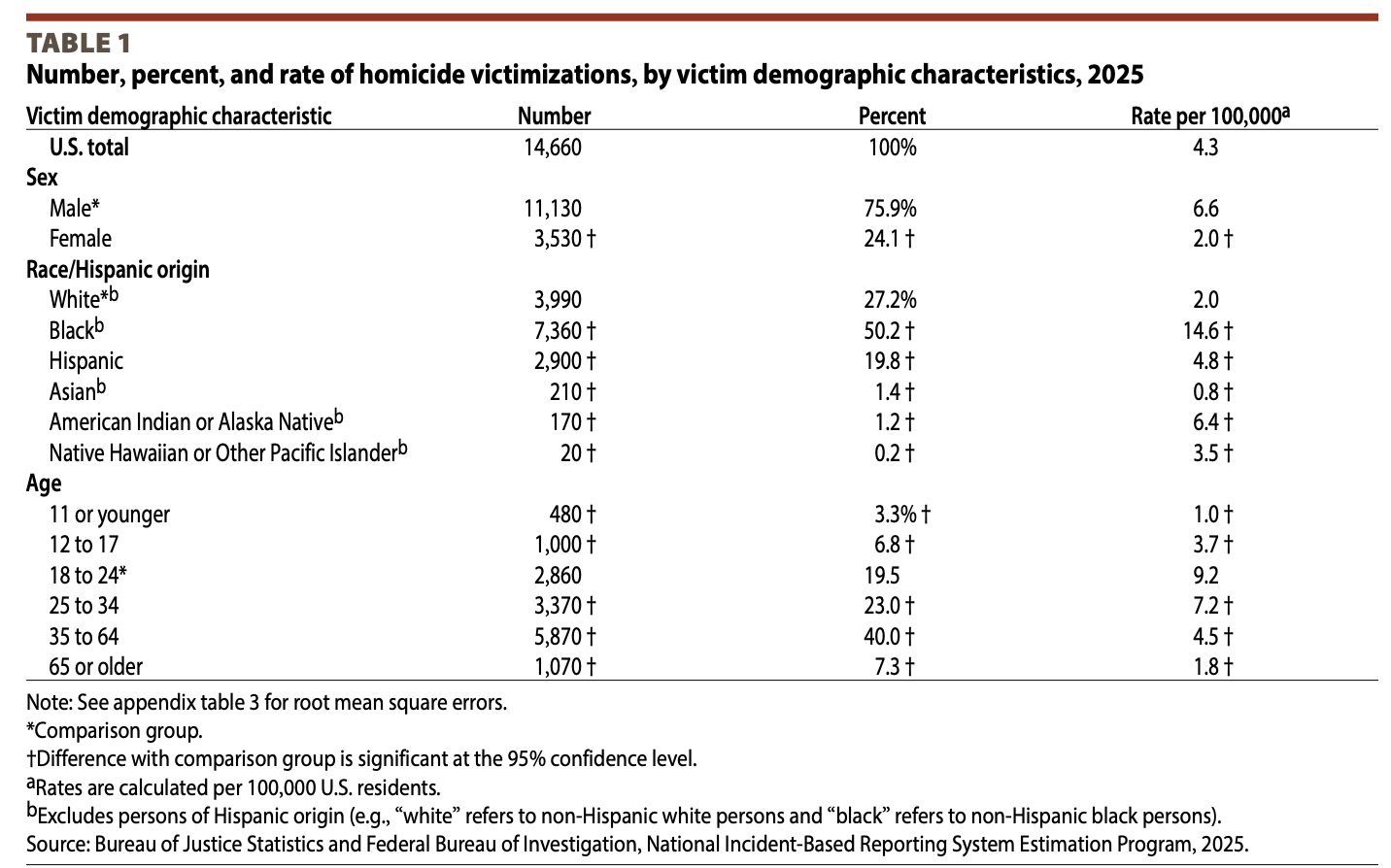
In 2025, there were an estimated 14,660 homicide victimizations in the United States, a rate of 4.3 homicides per 100,000 persons.
This rate constituted a 17% decrease from 2024 (5.2 per 100,000) and a 30% decrease from 2023 (6.1 per 100,000).
Homicide refers to the offenses of murder and nonnegligent manslaughter and is defined as “the willful (nonnegligent) killing of one human being by another.”
Findings in this report are based on the Bureau of Justice Statistics’ and FBI’s National Incident-Based Reporting System (NIBRS) Estimation Program and the FBI’s Supplementary Homicide Reports (SHR).
Chart
HIGHLIGHTS For 2025
The rate of homicide victimization was 4.3 per 100,000 persons. This marks a 17% decrease from the rate of 5.2 per 100,000 in 2024.
The male homicide victimization rate (6.6 per 100,000 persons) was more than 3 times greater than the homicide victimization rate for females (2.0 per 100,000).
The homicide victimization rate for black persons (14.6 per 100,000 persons) was more than 7 times the rate for white persons (2.0 per 100,000).
The largest percentage of homicide victimizations (42%) was committed by someone outside the family but known to the victim.
Females (0.8 per 100,000 persons) experienced a higher rate of intimate partner homicide than males (0.5 per 100,000).
Most homicide incidents (93%) involved one victim.
The percentage of homicide victimizations involving a firearm was 76%, compared to 73% in 2016.
Fifty-four percent of homicide victimizations were cleared by arrest and 41% were not cleared.
In 2025, black persons experienced the highest homicide victimization rate compared to persons of all other racial or Hispanic origin groups.
Males represented the majority (76%) of homicide victims in 2025 and experienced a homicide victimization rate of 6.6 per 100,000 persons.
By comparison, the female homicide victimization rate (2.0 per 100,000) was lower.
Compared to the homicide victimization rate for white persons (2.0 per 100,000) in 2025, the homicide rate was higher for black persons (14.6 per 100,000), American Indian or Alaska Native persons (6.4 per 100,000), Hispanic persons (4.8 per 100,000), and Native Hawaiian or Other Pacific Islander persons (3.5 per 100,000).
Asian persons had the lowest homicide victimization rate in 2025 (0.8 per 100,000).
In 2025, the highest homicide rate by age group was experienced by persons ages 18 to 24 at 9.2 per 100,000 persons, followed by persons ages 25 to 34 at 7.2 per 100,000.
The largest percentage of homicide victimizations was committed by someone outside the family but known to the victim
In 2025, 42% of homicide victimizations were perpetrated by someone outside the family but known to the victim.
Among homicides of males, 48% were perpetrated by someone outside the family but known to the victim.
Among homicides of females, 41% were committed by an intimate partner (i.e., current or former spouse, boyfriend, or girlfriend).
Overall, homicides of females were more likely than homicides of males to be perpetrated by a family member (a current or former intimate partner or other family member).
Perpetrators of homicides against males were more likely than perpetrators of homicides against females to be non-family (outside of family but known to victim, stranger, or unknown).
Homicide victimizations of white persons (21%) were more likely to be perpetrated by an intimate partner than those of Hispanic (15%), black (12%), or American Indian or Alaska Native (10%) persons.
Asian persons had a larger share of homicide victimizations perpetrated by an intimate partner (25%) than white persons.
Asian and Hispanic persons were more likely than white, black, American Indian or Alaska Native, or Native Hawaiian or Other Pacific Islander persons to experience homicide victimization from a stranger.
For victims in each age group from 12 to 64, the homicide was more likely to involve a perpetrator who was outside the family but known to the victim than any other victim-offender relationship.
Among victims age 11 or younger (88%) and 65 or older (34%), the most common victim-offender relationship was the category other family member.
Females had a higher rate of intimate partner homicide than males
The overall rate of homicide victimization perpetrated by an intimate partner was 0.7 per 100,000 persons in 2025.
Females had a higher rate of intimate partner homicide (0.8 per 100,000) than males (0.5 per 100,000).
For all other victim-offender relationship types, males experienced higher rates of homicide victimization than females.
In 2025, black persons (1.8 per 100,000) experienced the highest rate of intimate partner homicide compared to persons in each of the other race or Hispanic origin categories.
Black persons also had the highest rate of homicide victimization for the victim-offender relationship outside of family but known to the victim at 6.3 per 100,000.
This was more than seven times the rate for white persons (0.8 per 100,000) and three times the rate for Hispanic persons (2.0 per 100,000).
The rate of homicide victimization for individuals ages 18 to 24 (4.9 per 100,000) was highest when the offender was outside the family but known to the victim.
Among those age 11 or younger (0.9 per 100,000), the highest rate of homicide victimization involved an offender who was a family member.
More than 90% of homicide incidents involved one victim
In 2025, 93% of homicide incidents involved one victim, accounting for 12,670 of the 14,660 total homicide victims.
An estimated 6% of homicide incidents involved two victims, and fewer than 2% of homicide incidents involved three or more victims.
The percentage of homicide victimizations involving a firearm decreased between 2022 and 2025
The percentage of homicide victimizations involving a firearm was 73% in 2016 and 76% in 2025.
Between 2022 and 2025, the percentage of firearm-involved homicides declined from 80% to 76%.
Firearms were the most common type of weapon involved in homicides.
In 2025, 76% of homicide victimizations involved the use of a firearm.
Knives, blunt instruments, personal weapons, and other non-personal weapons were each involved in fewer than 15% of homicide victimizations.
Firearms were involved in more than 6 in 10 homicide victimizations for persons who were white, black, Hispanic origin, or Asian.
The largest percentage of firearm-involved homicides by race or Hispanic origin was among black homicide victims (86%).
More than 70% of homicide victimizations in age groups 12 to 64 involved firearms.
Fewer than half of homicide victimizations among persons age 65 or older involved a firearm (43%).
Three in 10 homicide victimizations among persons age 11 or younger involved a firearm (29%) or personal weapon (33%).
Over half of homicide incidents in 2025 resulted in case clearance
In 2025, the percentage of homicide incidents cleared by arrest or exceptional means was 59%.
This was similar to the percentage cleared in 2024 (59%) but larger than the percentage cleared in 2023 (56%) and 2022 (53%).
Exceptional clearance was more than three times as common for females than for males
Note: See the appendix for explanations of homicides cleared or solved.
In 2025, 54% of homicide victimizations were cleared through arrest and 41% were not cleared.
Fewer than half of male homicide victimizations were not cleared (42%), which was larger than the percentage of female homicide victimizations that were not cleared (35%).
Fifty-seven percent of homicide victimizations of white persons were cleared through arrest, while 33% were not cleared.
Compared to homicide victimizations of white persons, homicide victimizations of black and Hispanic persons were less likely to be cleared through arrest (51% and 55%) and more likely to not be cleared (45% and 39%).
Half (51%) of homicide victimizations of persons ages 18 to 24 were cleared through arrest, which was less than the percentage cleared for those in age groups 17 or younger and 35 or older.
Homicide victimizations of females (12%) were more likely to be cleared by exceptional means than those of males (3%).
White persons (10%) had a higher percentage of exceptional clearance than persons who were Asian (7%), Hispanic (5%), black (3%), or American Indian or Alaska Native (1%).
Persons age 65 or older (11%) had the highest percentage of exceptional clearance compared to all other age categories (i.e., cleared because the offender died, the prosecution was declined, the victim refused to cooperate, extradition of the offender was denied by another jurisdiction, or the offender was a juvenile but no referral was made to the juvenile court as a matter of accepted law enforcement policy).
Appendix
Cleared through arrest: Includes any on-view arrest that occurs absent a warrant or previous incident report, arrests where an offender is taken into custody based on a warrant or previously submitted incident report, and incidents for which an offender is issued a summons to appear in court but not taken into police custody.
Exceptional clearance: Occurs when an incident is cleared without an arrest due to circumstances outside of the control of law enforcement. To clear an offense by exceptional means, agencies must meet the following criteria: an investigation must have clearly established the identity of a least one offender; there must be sufficient probable cause to support the arrest, charging, and prosecution of the offender; law enforcement must know the exact location of the offender so that an arrest could be made had circumstances not prevented the arrest; and there must be a reason outside the control of law enforcement that prevents law enforcement from making an arrest and charging the offender.
Exceptional clearance includes: the death of the offender (e.g., suicide or justifiably killed by law enforcement or citizen); the prosecutor’s decision to decline prosecution of the case after it was referred from law enforcement; the victim’s refusal to cooperate with the prosecution after the offender had been identified; the denial of extradition because the offender had committed a crime in another jurisdiction and is being prosecuted for that offense; the offender was a juvenile and not taken into police custody.
An incident cannot be cleared by exceptional means if it was previously or concurrently reported as cleared by arrest.
Not cleared: A crime incident that is not reported in NIBRS as cleared by an arrest or exceptional means is considered not cleared. Incidents that are administratively closed do not necessarily meet the criteria to be reported as cleared.
NIBRS does not record information on administrative case closures. These definitions come from the NIBRS User Manual. For more information, see the manual at https://le.fbi. gov/informational-tools/ucr/ucr-technical-specificationsuser-manuals-and-data-tools
Privacy Policy
We do not collect your personal information. See our privacy policy at “About This Site.”
See More
See more articles on crime and justice at Crime in America.
Most Dangerous Cities/States/Countries at Most Dangerous Cities.
US Crime Rates at Nationwide Crime Rates.
National Offender Recidivism Rates at Offender Recidivism.
The Crime in America.Net RSS feed (https://crimeinamerica.net/?feed=rss2) provides subscribers with a means to stay informed about the latest news, publications, and other announcements from the site.