
Highlights
This article is available as a YouTube podcast.
An overview of how the USDOJ counts crime, including the use of the National Crime Victimization Survey.
“If” the FBI is counting only one crime per incident (instead of multiple crimes per incident) for its annual reports, it means that the number of crimes reported in any jurisdiction is likely a vast undercount.
Using state counts of multiple state charges per incident from Harvard (below), there may be double or triple the amount of crimes reported by the FBI in their annual crime reports (see appendix for the FBI’s response). This is not an estimate, projection, or claim—only an illustration of the potential scale of undercounting if multiple offenses per incident are excluded.
The National Crime Victimization Survey from the USDOJ’s Bureau of Justice Statistics (see appendix) states that most crimes are not reported to law enforcement. Recent NCVS reports offer a considerable increase in rates of violence for the last three years.
The FBI’s National Incident-Based Reporting System (NIBRS) was designed to change how we count and understand crimes reported to law enforcement. It changes the number of crimes per incident from one to ten.
I wish national and local crime counts were simple. It’s the wild west of sociology. Anyone can make any claim they want about crime based on data from the US Department of Justice.
Official crime counts don’t lie, but they don’t tell the whole truth either.
CrimeinAmerica.Net-Chat GPT’s “Top 10 Sources for Crime in America” based on primary statistical sources with trusted secondary analysis.
Crime in America.Net-“Trusted Crime Data, Made Clear.”
Quoted by The Associated Press, USA Today, A&E Television, the nationally syndicated Armstrong Williams Television Show (30 times), Department of Justice documents, multiple US Supreme Court briefs, C-SPAN, the National Institute of Health, college and university online libraries, multiple books and journal articles, The Baltimore Sun, The Capital Gazette, MSN, AOL, Yahoo, The Daily Beast, The Huffington Post, JAMA, News Break, The National Institute of Corrections, The Office of Juvenile Justice And Delinquency Prevention, The Bureau of Justice Assistance, Gartner Consulting, The Maryland Crime Victims Resource Center, Law.Com, The Marshall Project, The Heritage Foundation via Congressional testimony, Law Enforcement Today, Law Officer.Com, Blue Magazine, Citizens Behind The Badge, Police 1, American Peace Officer, Corections.Com, Prison Legal News, The Hill (newspaper of Congress), the Journal of Offender Monitoring, Inside Edition Television, Yomiuri Shimbun (Asia’s largest newspaper), LeFigaro (France’s oldest newspaper), Oxygen and allied publications, Forbes, Newsweek, The Economist, The Toronto Sun, Homeland Security Digital Library, The ABA Journal, The Daily Express (UK) The Harvard Political Review, The Millennial Source, The Federalist Society, Lifewire, The Beccaria Portal On Crime (Europe), The European Journal of Criminology, American Focus and many additional publications.
Sign up for notice of new articles on the front page of this site.
A comprehensive overview of crime for recent years is available at Violent and Property Crime Rates In The U.S.
Questions
What crimes is the USDOJ counting, and what crimes remain outside its reach?
Are law enforcement agencies reporting all eligible crimes per incident to the FBI?
Is the FBI only offering the primary crime to the public to keep crime statistics consistent?
How should policymakers and the public interpret reported crime data, knowing it captures only a small portion of criminal behavior?
Do citizens or policymakers care if all reported crimes are not counted? Is it simply a matter of honesty?
Americans are criticized by numerous major media publications for their massive fear of crime, according to Gallup, when reported crime statistics are down. Is it possible that a full count of all reported crime data and the use of the USDOJ’s National Crime Victimization Survey (a count of all crime) justifies their concerns?
As the director of public information for state and national criminal justice agencies, I have always believed that a spokesperson should go to the scene of any issue and experience it firsthand, seeing, tasting, smelling, touching, and fully comprehending what is happening.
The Maryland Department of Public Safety (I was their director of public information) took over the operations of the city jail from the city of Baltimore for fiscal reasons. The state built a brand new central booking center (plus more holding cells) where all arrests in the city were processed.
I spent an evening in the booking center watching staff enter criminal charges. It was obvious that most (not all) of those being processed had multiple criminal charges from one incident.
Burglaries contained other charges, such as possession of burglary tools, trespassing, possession of stolen goods, drug charges, and anything else the officer chose to include.
The Reason For Multiple Charges
There are few first-time offenders. The greater the number of charges, along with a documented criminal history and existing warrants (established through electronic processing of fingerprints), the greater the chance that the criminal would be denied bail.
In the officer’s mind, pretrial detention would be a favored consequence regardless of whether he is found guilty. For most arrests, the evidence is fairly cut and dry (i.e., he was caught inside a burglarized house, the victim identifies someone they know as the offender, not uncommon).
Denial of bail also protected victims from the fear that the criminal would quickly return and possibly commit greater harm. When I was a police officer, victims often expressed that fear.
But The Real Reason Is…..
But the real reason for multiple charges was the fact that the overwhelming majority of criminal cases (90 percent or more) are plea bargained. That means that burglary charges will be reduced to possession of stolen property, and the rest of the charges would be placed on hold (steted, Latin for “let it stand”) or dismissed “if” the offender pleads guilty.
The Criminal Justice System’s Prime Directive
If readers realize anything about the justice system, it’s the understanding that agencies must stay within their budgets; the prime directive from their bean counter overlords at the state or local levels.
The bottom line is the necessity that most defendants are persuaded through incentives not to ask for a jury trial except in extreme circumstances.
Ninety percent of all criminal cases use plea bargaining to dispose of criminal charges because the justice system has no choice. If defendants all chose jury trials, the justice system would collapse in a week.
The greater the number of criminal charges, the better the chance that the defendant will plead guilty to reduced and dismissed charges. Charge bargaining is one of several reasons why time served in prison is often short.
The average time served for a property offense is often minimal, per the USDOJ’s Bureau of Justice Statistics. For violent crimes, the median time served is 2.4 years; for property crimes, the median time served is 13 months; the median time served in state prison for all offenses is 1.3 years.
So the more charges offered before trial, the greater the chance for some sort of accountability for the victims, while recognizing that few felonies get prison time.
What Does All This Have To Do With The FBI’s National Incident-Based Reporting System And Crime Counts?
The nation primarily relies on the FBI for crime statistics (see the appendix for the US Department of Justice’s National Crime Victimization Survey). The National Incident-Based Reporting System is the FBI’s new (although it’s conceptually decades old) method of analyzing data to give us a better understanding of crime through police agencies supplying much more information per incident than previously requested (the FBI cannot compel participation).
Instead of recording one primary crime and its characteristics based on the previous counting system (the Summary Reporting System), the NIBRS could record up to ten crimes and their characteristics. See the FBI’s response in the appendix. The issue remains unresolved; we don’t know if local law enforcement is providing one primary crime or all crimes per incident.
Counting all crimes runs the risk of greatly increasing the number of illegal acts in any city or state. That runs the risk of an immense amount of negative media publicity for any jurisdiction. That’s probably the reason why it took so long for police agencies to adopt the system, along with costs, IT complexity, and training burdens.
How did the FBI address this issue? It published an analysis indicating that less than10 percent of criminal incidents would involve multiple charges, and the overall impact on the politically important crime statistics would be minimal.
Per the report, “The agencies reporting NIBRS, which increased from 446 in 1991 to 5,154 in 2011, showed only 9.2 percent of reports contained more than one offense per incident. Users of UCR (Uniform Crime Reporting) data should be aware that when agencies switch from SRS (Summary Reporting System) data reporting to NIBRS reporting, they will not see apparent increases in agency crime rates. Because of the low number of multiple-offense incidents and the practice of reinstituting the hierarchy rule when converting NIBRS data to SRS data prior to publication, the level of crime should appear the same.”
Per a previous email conversation with the FBI, the report has not been updated.
Did anyone with experience in the justice system believe that multiple charges only apply to 9.2 percent of criminal incidents?
No, per the underlying criminal charging practices routinely observed in arrest processing, court data, and plea bargaining research.
What Does This Mean For Crime Statistics?
“If” we are counting only one crime per incident, it means that the number of crimes reported in any jurisdiction is likely a vast undercount. Beyond homicides, the failure to consistently capture and publicly summarize multiple offenses within single incidents results in substantial missing data.
Using state counts of multiple charges from Harvard (below), there “may” be double or triple the amount of crimes reported by the FBI in their annual crime reports (see appendix for the FBI’s response).
Is that a fault of the FBI’s NIBRS? No. They simply record what’s offered by local police agencies.
Does this change longitudinal (over time) national or local crime statistics? No.
It’s possible (I have limited data on the topic) that some or many law enforcement agencies continue to record and submit the principal crime per incident, not the 10 allowed via the NIBRS.
Before the NIBRS, the older Summary Reporting System only recorded one crime per incident. But regardless of what local law enforcement sends to the FBI, it’s in our national best interest to keep recording the primary crime to keep decades of crime statistics consistent. But all crimes need to be counted (and published) to gain a full understanding of criminality
What Does This Mean For Our Understanding Of Crime?
The purpose of the NIBRS was to provide a qualitative understanding of criminal incidents. Limiting the number of crimes reported by local law enforcement does not fulfill that mission. Science and possible solutions suffer.
In real-world criminal justice practice, incidents frequently involve multiple criminal acts:
-
Assault combined with weapons violations
-
Burglary paired with trespassing and property damage
-
Domestic violence incidents involving assault, threats, and protection-order violations
-
Drug cases involving possession, paraphernalia, and distribution indicators
Yet NIBRS data rarely reflect this complexity because police agencies may not be sending all the crime data per incident they have. The FBI, in their response below, states that all submitted crime is used for their reports on individual crimes.
Is There Data on Multiple Criminal Offenses Per Incident?
Am I refuting the FBI’s data that there would only be 9.2 percent of multiple criminal cases per incident?
Yes.
Am I suggesting that most (not all) arrests have multiple criminal charges? It’s probable based on the Harvard study below.
There is a long history of data on “overcharging” or “crime stacking” within the criminological literature. It criticizes the practice of multiple criminal charges per incident. They suggest that it’s unfair to the defendant; multiple criminal charges could induce an innocent person to plead guilty, especially if he is being held in jail on a pretrial basis.
Is there a central database of crime stacking? No, there is not. Do we have exact numbers on overcharging in the US? No.
While NIBRS does not track criminal charges or court outcomes, there is extensive legal and criminological research showing that multiple charges arising from a single criminal episode are routine.
Legal scholars have long described two common prosecutorial practices:
-
Horizontal overcharging: filing multiple charges for the same course of conduct
-
Vertical overcharging: charging offenses at higher severity levels to increase leverage
Research and decades of subsequent scholarship document that charging multiple offenses is a central feature of plea bargaining, not an exception.
The Harvard Study
More recent empirical work reinforces this point. A Harvard Law Review study examining charge stacking across jurisdictions found that cases involving multiple charges are common and correlate with higher conviction rates, indicating that charging multiplicity plays a meaningful role in case outcomes. The study provides lists of multiple charges for a few states and the federal government.
All criminal charges are not necessarily equivalent to NIBRS offenses, but they provide insight into the frequency of multi-violation criminal episodes.
Harvard data shows the percentage of criminal cases that have a certain number of criminal charges in Arkansas, Florida, Pennsylvania, and Tennessee. In Florida, for example, the majority of criminal cases have only a single charge (64%, 1,522,480 cases). In Pennsylvania, the majority of cases have two charges or more (86%, 724,911 cases). Arkansas and Tennessee primarily recorded multiple criminal charges.
These preliminary results suggest that in some states, multiple-offense cases reflect a minority of cases (Florida), while in others, they reflect a majority (the three other states measured).
“If” the four states cited are representative of all states and their charging practices, it suggests (not proves) that actual crime counts may be far higher than what is offered by the FBI in their annual crime reports.
Chart
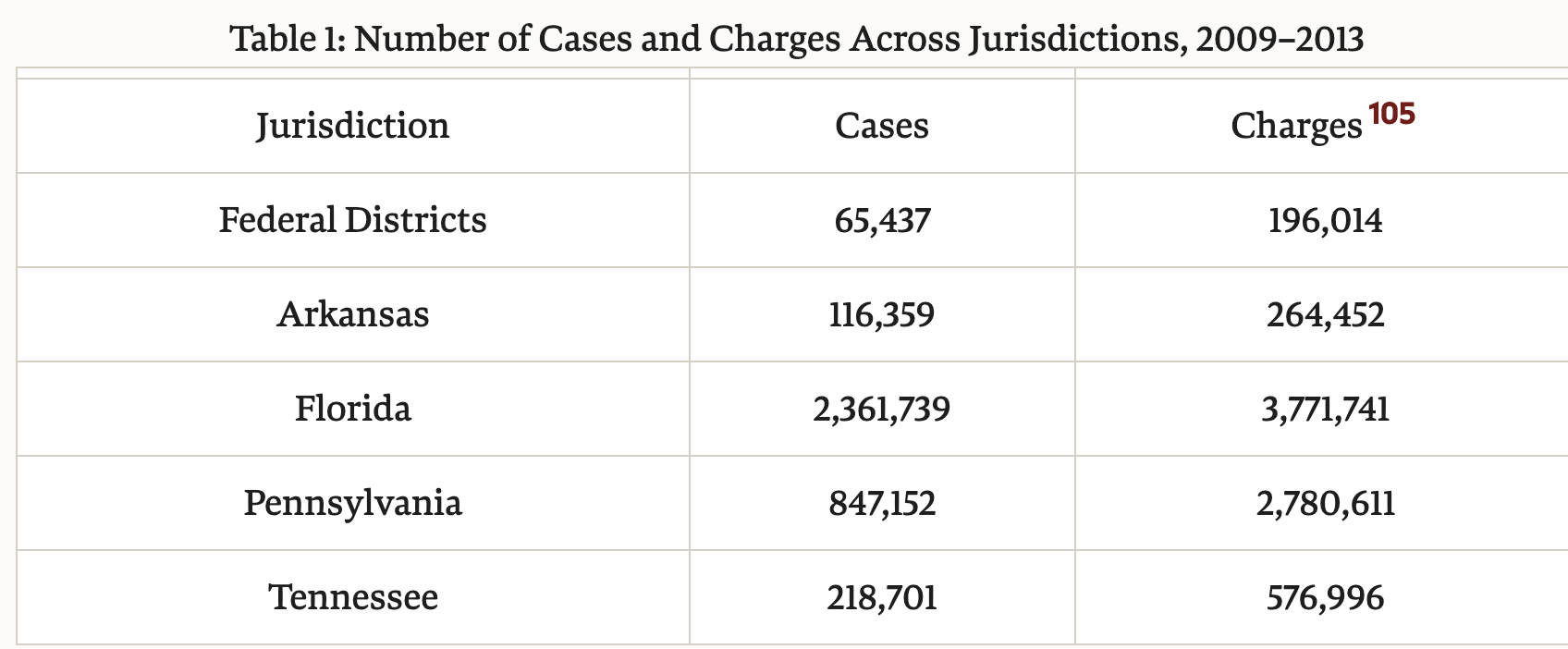
Am I suggesting that many criminal cases—and by extension many arrests—involve multiple charges? That appears probable based on the Harvard study.
Reviews by the Vera Institute and others conclude that broad charging discretion is one of the primary sources of prosecutorial leverage, especially in a system where the overwhelming majority of cases are resolved by guilty pleas.
None of this research proves how many crimes should appear in NIBRS per incident or case. But it does undermine the notion that most criminal incidents (90 percent) involve only one offense.
Can A Law Enforcement Agency Change The Number Of Crimes Recorded After Booking?
Per ChatGPT, NIBRS captures all offenses known to law enforcement within an incident as recorded in the agency’s records system. What is submitted to the FBI generally originates from the booking and preliminary investigation process, but agencies can update offense data as their internal investigations evolve. No provision in NIBRS requires post-booking changes to propagate automatically — and in practice, many agencies do not routinely update NIBRS submissions when court dispositions change.
Note that law enforcement has lost approximately 25,000 police officers and employees, according to the Bureau of Labor Statistics, and most large police agencies state that they are significantly understaffed. Also note that there has been a 25-50 percent reduction in arrests. It has been my experience that there are multiple issues with updating criminal records beyond the scope of this discussion.
One More Thing To Consider: Problems With Jurisdictions Downgrading Crimes
When I left law enforcement and went to college, one of my first criminology courses discussed how “some” law enforcement agencies provided inaccurate or downgraded crime statistics (i.e., robberies classified as thefts). This may be happening in Washington, D.C., Oakland, CA, Memphis, TN, and multiple other cities, which brings another level of complexity to the discussion of crime numbers. City crime statistics can have an oversized impact on state crime numbers.
Conclusions-Summation
I changed this submission from “article” to “opinion” because I cannot prove that local law enforcement is (or is not) sending all eligible criminal charges (up to 10) through the FBI’s National Incident-Based Reporting System. It’s possible that some agencies are sending multiple crimes per incident (up to 10) to the FBI, while others are not.
Approximately 75 percent of American law enforcement agencies are using NIBRS, covering a large majority of the US population.
Based on the Harvard study (above), the actual crime count for the nation “may” be double or triple the numbers presented by the FBI’s yearly summations. We simply do not know.
While NIBRS allows police agencies to report multiple offenses per incident, national or local crime statistics may present selective summaries—often emphasizing incidents or victims rather than total offenses. As a result, a single criminal episode involving burglary, violence, drug possession, and trafficking may appear as one crime in public reporting, despite constituting multiple criminal violations.
Then there is the “so what” question. A burglary remains a burglary until it’s downgraded via plea-bargaining. But the arrest charge for burglary remains; it happened. Does it really matter if the burglary is accompanied by three additional crimes as long as the primary crime during the incident is recorded (assuming that the burglary is not downgraded to a lesser charge through a plea)? Critics will suggest that if a law enforcement agency only submits the primary crime, what’s the harm?
This approach preserves long-term statistical consistency for local and national crime reports but substantially understates the volume and complexity of criminal behavior known to law enforcement.
The FBI’s emphasis on incident and victim-based summaries reflects legitimate concerns about trend continuity, cross-jurisdictional comparability, and public comprehension—not an attempt to mislead. However, these choices come at the cost of understating the full scope of criminal behavior known to law enforcement.
Understanding the full scope of criminal behavior matters because counting only the primary offense accurately tracks incidents, but it distorts the scope of criminal behavior, the demands placed on the justice system, the risks experienced by victims and communities, and the evaluation of crime-control strategies. Primary-offense counts are sufficient for trend tracking, but may be insufficient for understanding crime.
There’s also the question of whether citizens want or care about a full count of crime. The social scientist in me wants to know everything to get a better understanding of crime, but to citizens, including a count of all crimes may be a moot point as long as the incident and primary crime is reported.
Yet I’m guessing that citizens want to know everything. They want honesty about what numbers do and don’t capture, reassurance that their experience is not being dismissed, and acknowledgment that crime is more than a single label. In other words, citizens may not want all the data, but they want the truth about the data.
Only 13 percent of rapes and sexual assaults are reported to law enforcement in urban areas, per the Bureau of Justice Statistics. That crime statistic may reveal that citizens believe that their crimes will not be taken seriously. How crime statistics are perceived impacts public safety.
Do I or anyone else know the true number of criminal charges involving multiple criminal offenses that could or should be recorded by the FBI’s National Incident-Based Reporting System?
Is Urban Crime Really Dropping? The National Crime Victimization Survey
I’m sorry, I’m about to make a confusing issue more complex.
There are two USDOJ measures of crime in the United States. One is based on crimes reported to law enforcement, as articulated by the FBI, and that’s what people are basing the reduction in violent crime on. Yes, homicides are obviously the most reported and reliable crime statistic. No one disputes the drop in homicides or the overall violence reduction in cities based on crimes reported to the police.
The problem? It would take several additional pages of explanations as to the endless problems surrounding the use of reported crimes, so I’ll stick with the most obvious: the vast majority of what we call crime is not reported to the police.
Seventy percent of what we call crime are property events and, per the Bureau of Justice Statistics, only 30 percent of those are reported to the police. Close to half of violent crimes are reported.
Per the USDOJ’s Bureau of Justice Statistics recent report, 38 percent of urban violent crimes are reported.
Based on unreported crimes, it’s theoretically possible (but unlikely) for the 3-4 percent decrease (2023-2024) per the FBI in national violent crime to actually be an increase.
“But”
But per the USDOJ’s Bureau of Justice Statistics National Crime Victimization Survey (what the US Census calls the premier method of counting crimes in America), we had a large increase in rates of violent crime in 2022 (44 percent), and rates have remained almost unchanged for 2023 and the latest-most recent report for 2024.
The National Crime Victimization Survey states that urban violence increased in its latest 2024 report. Independant alalyists say that violent and property crimes are falling considerably in cities.
One source claims the increase in rates of violent crime is 80 percent, based on the National Crime Victimization Survey. That finding, however, includes a baseline of 2020 when the pandemic raged, and surveys and counts of crime were impacted.
So it’s plausible, based on the totality of crime as measured by the National Crime Victimization Survey, that there have been historic increases in violent crime during recent years. The NCVS does not count homicides (you can’t interview dead people), and it excludes business crimes, those under the age of 12, and other categories.
We should also note that per Gallup, the overwhelming majority of those polled indicate a fear or concern about crime, with half expressing serious concerns.
Privacy Policy
We do not collect your personal information. See our privacy policy at “About This Site.”
See More
See more articles on crime and justice at Crime in America.
Most Dangerous Cities/States/Countries at Most Dangerous Cities.
US Crime Rates at Nationwide Crime Rates.
National Offender Recidivism Rates at Offender Recidivism.
The Crime in America.Net RSS feed (https://crimeinamerica.net/?feed=rss2) provides subscribers with a means to stay informed about the latest news, publications, and other announcements from the site.
One Reply to “Official Crime Counts May Dramatically Understate US Criminality”