

Highlights
This article is available via a YouTube Video.
Rapes and sex assaults reported to law enforcement have plummeted, per the latest full-year report from the US Department of Justice.
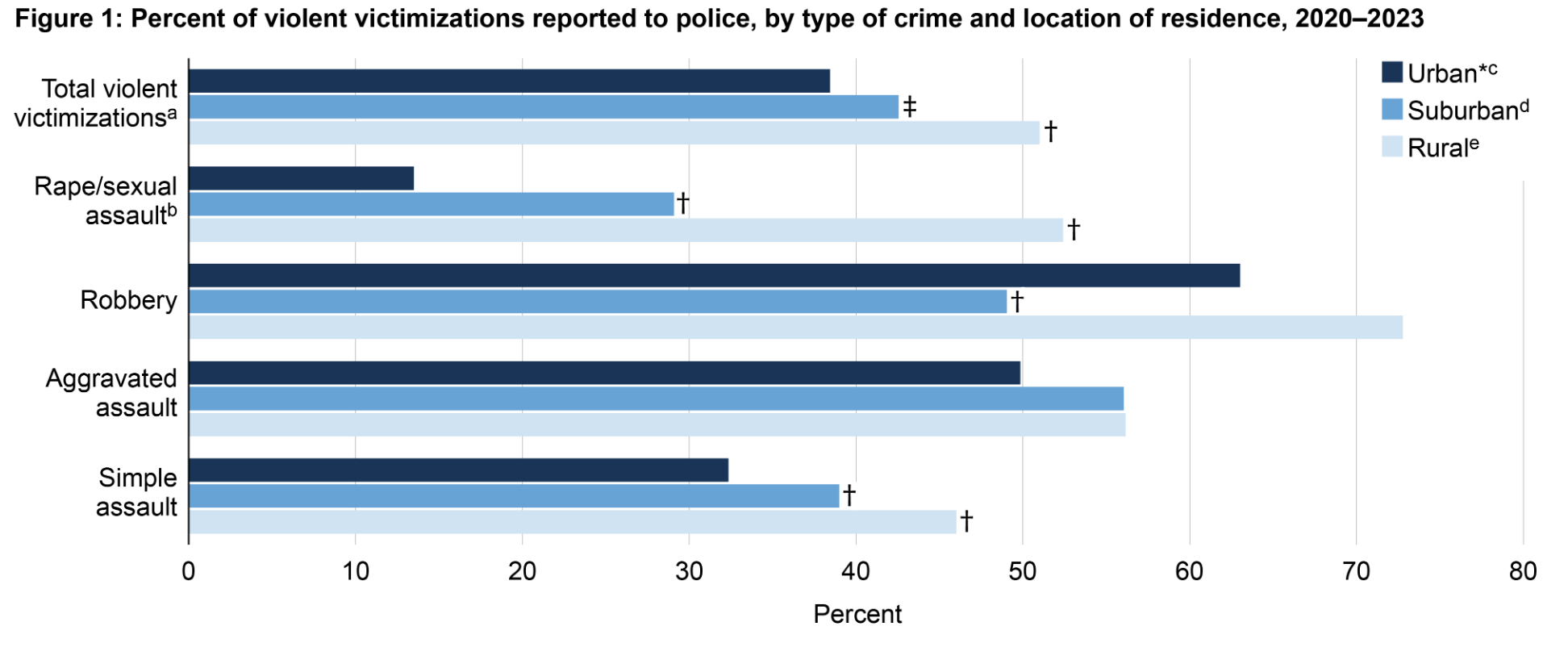
Only 13 percent of rapes and sexual assaults in urban areas are reported.
Few sex assaults end in prosecution and convictions.
It seems that sex offenders are operating with impunity due to the lack of reporting and prosecution, especially in urban areas.
The Guardian ‘These men think they’ve done nothing wrong’: When 50 men went on trial in France, accused of raping a woman who had been drugged by her husband,
Crime in America.Net-“Trusted Crime Data, Made Clear.”
Quoted by The Associated Press, USA Today, A&E Television, the nationally syndicated Armstrong Williams Television Show (30 times), Department of Justice documents, multiple US Supreme Court briefs, C-SPAN, the National Institute of Health, college and university online libraries, multiple books and journal articles, The Baltimore Sun, The Capital Gazette, MSN, AOL, The Daily Beast, The Huffington Post, JAMA, News Break, The National Institute of Corrections, The Office of Juvenile Justice And Delinquency Prevention, The Bureau of Justice Assistance, Gartner Consulting, The Maryland Crime Victims Resource Center, Law.Com, The Marshall Project, The Heritage Foundation via Congressional testimony, Law Enforcement Today, Law Officer.Com, Blue Magazine, Corections.Com, Prison Legal News, The Hill (newspaper of Congress), the Journal of Offender Monitoring, Inside Edition Television, Yomiuri Shimbun (Asia’s largest newspaper), LeFigaro (France’s oldest newspaper), Oxygen and allied publications, Forbes, Newsweek, The Economist, The Toronto Sun, Homeland Security Digital Library, The ABA Journal, The Daily Express (UK) The Harvard Political Review, The Millennial Source, The Federalist Society, Lifewire, The Beccaria Portal On Crime (Europe), The European Journal of Criminology, American Focus and many additional publications.
Sign up for notice of new articles on the front page of this site.
A comprehensive overview of crime for recent years is available at Violent and Property Crime Rates In The U.S.
Article
On Oct. 15, 2017, actress and activist Alyssa Milano tweeted that women who had been sexually harassed or assaulted should write “Me too” as a status. Within hours, tens of thousands had taken up the #MeToo hashtag.
The question is, has it made a difference when it comes to sexual assaults?
When I left law enforcement and went to college, I was told that the majority of rapes and sex offenses are not reported to law enforcement. But when 13 percent for urban areas and 24 percent for the US are reported, and with the lack of prosecution, what does that say about our ability to protect our wives, daughters, and all females?
We endlessly debate crime statistics and the meaning of rates and numbers, but it seems that our ability to report, investigate, and prosecute sex offenses needs reexamination.
A 12-year-old girl reported her great uncle, her adoptive parent, had been sexually abusing her for about three years, but authorities in Florida did not believe her, according to a new federal lawsuit.
Now an adult, Taylor Cadle is suing over the investigation that led to her being wrongfully prosecuted instead of her uncle, Henry Cadle, before he was criminally charged and sentenced.
This time, Taylor Cadle captured videos and photos as evidence, according to the complaint. She called 911 that evening, on July 25, 2017, and shared the images with a responding officer.
Henry Cadle was charged with two counts of sexual battery, the complaint says. In February 2019, he was sentenced to 17 years in prison after pleading no contest.
National Crime Reporting Statistics
According to a recently released report from the National Crime Victimization Survey from the Bureau of Justice Statistics of the US Department of Justice, only 13 percent of urban rapes and sexual assaults are reported to law enforcement over three years. “Urban” means cities of 50,000 plus.
The 50-year-old National Crime Victimization Survey is a product of the Bureau of Justice Statistics of the U.S. Department of Justice. It’s a measure of all crime rather than a count of reported crime as offered by the FBI. The majority of violent and property crimes are not reported to law enforcement.
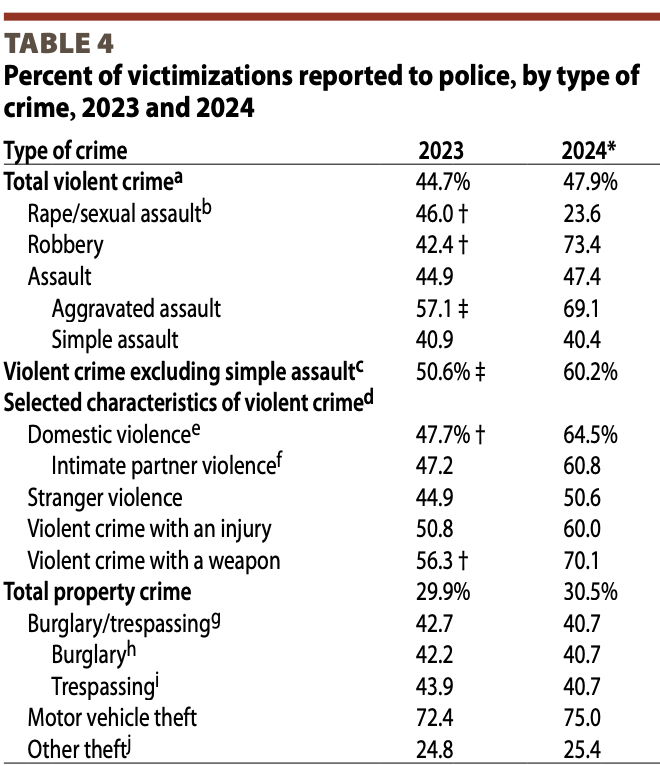
According to the recently released full-year report from the National Crime Victimization Survey, there is a huge decline in reported rapes and sexual assaults in the United States. Where the reporting of most crimes has increased, reporting for rapes-sex offenses has plummeted from 46 percent in 2023 to 23.6 percent in 2024.
Chart-Crimes Reported To Law Enforcement-National Crime Victimization Survey
Crimes Reported To Law Enforcement In Urban Areas
Per the National Crime Victimization Survey, only 13 percent of rapes and sex offenses were reported to law enforcement in urban areas over three years.
- About 38% of violent victimizations in urban areas were reported to police, which was lower than the percentages in suburban (43%) and rural (51%) areas.
- The percentage of rape and sexual assault victimizations in rural areas that were reported to police (52%) was almost four times higher than the share reported to police in urban areas (13%), and almost two times higher than the share reported in suburban areas (29%).
Chart
Less than 4% of reported rapes, sexual assaults, and child sex abuse allegations in certain cities across the United States ever result in a sex crime conviction, an NBC News 2025 investigation found.
The results of the investigation — based on a review of thousands of documents from police departments, prosecutors and courts in cities from Los Angeles to Boston — underscore what many advocates, experts and some law enforcement authorities have long said: The system routinely fails to get justice for victims.
NBC News and 10 local NBC stations spent more than a year tracing offenses from crime to conviction and found:
- Violent sex crimes have a lower arrest rate than most violent crimes.
- In Chicago, Black victims of sex crimes are the least likely to see a conviction.
- Those accused of violent sex crimes were often able to secure plea deals that would keep them off the sex offender list. This happens even in California, which usually prohibits the practice.
“A fraction of cases that get reported to police, a tiny fraction, end up resulting in any kind of sentence for the person accused,” Northwestern University law professor Deborah Tuerkheimer, a former assistant district attorney in Manhattan, told NBC 5 Chicago. In her book “Credible: Why We Doubt Accusers and Protect Abusers,” Tuerkheimer said cases can be dismissed due to a host of factors, like failure to take a case seriously or constrained resources.
Note: The findings above will depend on the jurisdiction examined and how convictions are defined.
Prosecution-University Of Massachusetts
For every 100 rapes and sexual assaults of teenage girls and women reported to police, only 18 lead to an arrest, according to a study conducted by three professors in the School of Criminology and Justice Studies under a $1.19 million grant from the National Institute of Justice.
Ultimately, fewer than 7 percent – 189 out of 2,887 rape and sexual assault reports made to police over two years in six jurisdictions – resulted in convictions.
The researchers’ analysis, which included a review of police and court records along with in-depth interviews with police investigators and prosecutors, suggests that one major problem is the overuse and misuse of “exceptional clearance” and “open/inactive” designations when prosecutors think they cannot win at trial.
“A lot of times, detectives felt like they had really good, solid cases with enough evidence to make an arrest, but prosecutors declined to go forward,” Morabito says.
Police and prosecutors cited victims’ lack of cooperation as a major cause of closing cases with “exceptional clearance” or for designating them as inactive. But that’s problematic, too, Morabito and Pattavina say.
“Victims may feel they’re not being treated with respect by police or prosecutors, or they might not have the resources to keep going back for interviews that require them to take time off from work, find child care, or something else,” Pattavina says. “We need to understand what part of case attrition is victim decision-making and what part is a lack of resources.”
Why Survivors Decide Not to Report
Reporting sexual violence is never easy. Survivors who didn’t report to police gave the following reasons for their decision:
- 20% feared retaliation
- 13% believed the police would not do anything to help
- 13% believed it was a personal matter
- 8% reported to a different official
- 8% believed it was not important enough to report
- 7% did not want to get the perpetrator in trouble
- 2% believed the police could not do anything to help
- 30% gave another reason or did not cite one reason
Conclusions
During a time when Gallup states that fear of crime is at near record levels, victims of rapes and sexual assaults being reported to law enforcement are plummeting.
The reporting of rapes and sexual assaults nationally declined considerably for the recent yearly report from the National Crime Victimization Survey.
Only 13 percent of urban rapes and sexual assaults are reported to law enforcement.
It seems that sex offenders are operating with increasing impunity, especially in urban areas.
Again, what does this have to say about protecting the well-being of our wives, daughters, and all females? I understand that the majority of violent crime involves non-strangers, and when it comes to sexual assaults, it’s often one person’s word against another.
It’s also an issue of losing 25,000 police officers and employees, according to the Bureau of Labor Statistics, after the Defund the Police movement. Do we have enough veteran police officers to investigate crimes?
But the statistics above indicate that we have many miles to go in protecting all victims of violent crimes.
ChatGPT
This article was fact-checked by ChatGPT. It offered changes that were incorporated.
Methodological Considerations
The National Crime Victimization Survey interviews people aged 12 and above about their victimization experiences. Rapes and sexual assaults numbered 561,000 during the measurement period, compared with 642,000 robberies and 5,469,000 assaults. Smaller numbers can create less confidence in the outcomes. BJS notes that smaller sample sizes for rape/sexual-assault estimates reduce precision, and readers should interpret large year-to-year swings with caution. See the Methodology section of the full 2024 NCVS report for an explanation of the collection of sexual assault incidents. The NCVS does not include victims younger than 12 and does not measure business-related crimes.
Privacy Policy