

Highlights
This article is available as a podcast on YouTube.
The vast majority of urban violent and property crimes are not reported to the police.
The percentage of rape and sexual assault victimizations that were reported to police in urban areas was 13 percent. Most sexual assault offenders are not arrested or prosecuted.
Counting crimes is the wild west of sociology. But the current assessment by most media sources is that crime is declining, when there are very reputable sources suggesting that crime remains a huge problem in cities.
The National Crime Victimization Survey offers record increases in rates of violence.
Are we being honest with the American public?
Crime in America.Net-Chat GPT’s “Top 10 Sources for Crime in America” based on primary statistical sources with trusted secondary analysis.
Author
Leonard Adam Sipes, Jr.
Former Senior Specialist for Crime Prevention and Statistics for the Department of Justice’s clearinghouse. Former Director of Information Services, National Crime Prevention Council. Former Adjunct Associate Professor of Criminology and Public Affairs-University of Maryland, University College. Former police officer. Retired federal senior spokesperson.
Former advisor to presidential and gubernatorial campaigns. Former advisor to the “McGruff-Take a Bite Out of Crime” national media campaign. Produced successful state anti-crime media campaigns.
Thirty-five years of directing award-winning (50+) public relations for national and state criminal justice agencies. Interviewed thousands of times by every national news outlet, often with a focus on crime statistics and research. Created the first state and federal podcasting series. Produced a unique and emulated style of government proactive public relations.
Certificate of Advanced Study-The Johns Hopkins University.
Author of ”Success With The Media: Everything You Need To Survive Reporters and Your Organization,” available at Amazon and additional bookstores.
Crime in America.Net-“Trusted Crime Data, Made Clear.”
Quoted by The Associated Press, USA Today, A&E Television, the nationally syndicated Armstrong Williams Television Show (30 times), Department of Justice documents, US Supreme Court briefs, C-SPAN, the National Institute of Health, college and university online libraries, multiple books and journal articles, The Huffington Post, JAMA, The National Institute of Corrections, The Office of Juvenile Justice And Delinquency Prevention, The Bureau of Justice Assistance, Gartner Consulting, The Maryland Crime Victims Resource Center, The Marshall Project, The Heritage Foundation via Congressional testimony, Law Enforcement Today, Law Officer.Com, Blue Magazine, Corections.Com, Prison Legal News, The Hill (newspaper of Congress), the Journal of Offender Monitoring, Inside Edition Television, Yomiuri Shimbun (Asia’s largest newspaper), LeFigaro (France’s oldest newspaper), Oxygen and allied publications, Forbes, Newsweek, The Economist, The Toronto Sun, Homeland Security Digital Library, The ABA Journal, The Daily Express (UK) The Harvard Political Review, The Millennial Source, The Federalist Society, Lifewire, The Beccaria Portal On Crime (Europe), The European Journal of Criminology, American Focus and many additional publications.
Sign up for notice of new articles on the front page of this site.
A comprehensive overview of crime for recent years is available at Violent and Property Crime Rates In The U.S.
Article
We are in an intense debate over crime in Washington, D.C., and in all American cities and urban areas. Reporters and pundits claim with certainty that crime is down, and most (all?) media sources agree with this assessment based on reported FBI data.
The vast majority of what we refer to as crime is not reported to law enforcement. So, how can we know with certainty whether crime is up or down?
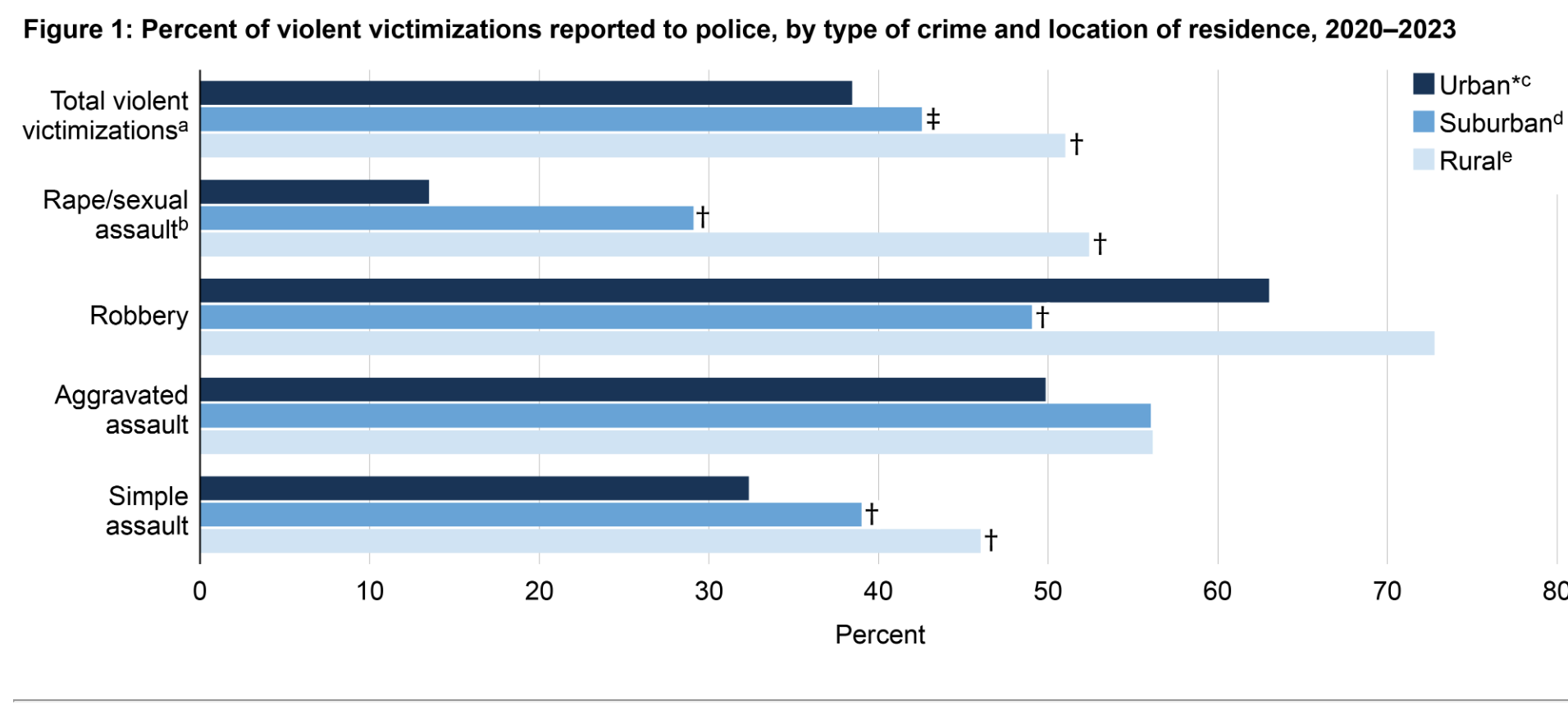
Data from the USDOJ’s Bureau of Justice Statistics National Crime Victimization Survey (NCVS) says that about 38% of violent victimizations in urban areas were reported to police.
It’s theoretically possible for violent crime to be increasing, not decreasing, based on the FBI’s assessment of a mere 4.5 percent reduction in violence for their latest yearly report for 2024.
The Bureau of Justice Statistics’ New Report About Crime Reporting
This article is based on a new report from the Bureau of Justice Statistics of the USDOJ documenting that the vast majority of crime is not reported to law enforcement.
Things To Consider
Fear of Crime: According to Gallup, we are experiencing near-record increases in fear of crime nationally. About 65 percent of D.C. residents told The Washington Post that crime was a “very” or “extremely” serious problem last year, even as violence declined. Per Axios, “As armed National Guard troops patrol the nation’s capital, a majority of Americans now see handling crime as a relative strength for President Trump, according to a new AP-NORC poll.” The recent poll from The Associated Press-NORC Center for Public Affairs Research finds a large majority, 68%, see crime as a “major problem” in large cities.”
National Crime Victimization Survey: The National Crime Victimization Survey in a 2023 report for the calendar year 2022, offered a continuing increase in violent crime in the nation’s history (44 percent), according to analyst Jeff Asher, and The Marshall Project. BJS’s 2023 NCVS shows rates similar to 2022, Bureau of Justice Statistics.
It remains the largest increase in violent crime in the nation’s history. The 2024 yearly NCVS report will be offered soon.
Summation
The current description of crime in American cities is based on incomplete data and currently ignores huge increases in violent crime per the NCVS, and concurrently disregards multiple data sources on fear of crime.
Bureau of Justice Statistics Description of Reported Crimes
This brief “Just the Stats” report presents findings on the percentage of victimizations reported to police by type of crime and location of residence for the aggregate period of 2020 through 2023. It details the percentage of both violent and property victimizations reported to police by type of crime and location of the victim’s residence. The data used to produce this report are from the National Crime Victimization Survey (NCVS). In the NCVS, victims’ residences can be classified as urban, suburban, or rural.
Highlights
About 38% of violent victimizations in urban areas were reported to police, which was lower than the percentages in suburban (43%) and rural (51%) areas.
The percentage of rape and sexual assault victimizations in rural areas that were reported to police (52%) was almost four times higher than the share reported to police in urban areas (13%), and almost two times higher than the share reported in suburban areas (29%).
Reporting to police for simple assault victimizations was higher in suburban (39%) and rural areas (46%) than urban areas (32%).
Simple assaults likely comprised roughly 55–60 percent of total violent victimizations per ChatGPT.
For robbery, the percentage of victimizations reported to police was lower in suburban areas (49%) than urban areas (63%). The percentage of robbery victimizations reported to police was not statistically different between urban and rural areas.
Chart
Property Crimes
Patterns in police reporting for property crime during 2020–2023 were similar to those for violent crime. A quarter (25%) of all property victimizations in urban areas were reported to police, which was lower than the percentages in suburban (33%) and rural (36%) areas.
Approximately 80 percent of what we call crime are property events. If 25 percent of property crimes are reported to the police in urban areas, then the overwhelming percentage of crime is not recorded in cities.
Notes
The Bureau of Justice Statistics aggregates multi-year data for more accurate results, but findings for a single year may be different.
I do not address the charge that cities are downgrading crimes, but the media have accused Oakland, CA, of inaccurate statistics, and the USDOJ is investigating accusations from police staff that Washington, D.C., is changing categories of crime. When I first studied criminology, a topic was cities that historically downplayed their crime statistics.
I do not offer all the reasons why people do not report crimes. When I became the senior specialist for crime prevention and statistics for the USDOJ’s clearinghouse, I asked the same question. I was told that many violent crime victims saw their assaults as personal matters or believed that the police could do nothing about property crimes. The NCVS does, however, offer more precise explanations in its annual reports.
See a definition of urban in the appendix.
Conclusions
Explaining the process of collecting crime data would require many more pages than this article; see Violent And Property Crime in The US for more.
It’s imprecise for me to suggest that our assessment of crimes reported to law enforcement is wrong based on the fact that we, within considerable limits, have been collecting and analyzing a small percentage of reported crime since the 1930s.
But it’s factually (ethically?) incorrect to dismiss the record increase in rates of violence reported by the National Crime Victimization Survey, the nation’s premier source of crime information per the US Census. It’s equally wrong to disregard the near record increases in fear or concern about crime, per Gallup and multiple additional sources.
The current discussion also ignores the fact that there are multiple sources stating a big increase in property crimes, including the FBI’s assessment that cybercrime losses are up 33 percent in 2024. Several sources state that many forms of property crime have substantially increased. Yet according to the FBI, property crime is down.
Counting crimes is the wild west of sociology, but the current assessment by most media sources is that crime is declining in cities based on small numbers of reported crimes, when there are very reputable sources suggesting that crime remains a problem for most citizens, while noting that the National Crime Victimization Survey offers record increases in rates of violence, while acknowledging that this could change in their upcoming report for 2024.
Is it fair to ask if we are having an honest conversation with the American public?
Use of ChatGPT For Fact Checking
ChatGPT fact-checked the article. ChatGPT was used to research two topics: the percentage of simple assaults compared to overall violent crime, and the note below.
The Bureau of Justice Statistics’ Definition of Urban
Per ChatGPT, the Bureau of Justice Statistics (BJS) does not have a single, fixed definition of “urban.” Instead, BJS adopts the classification schemes developed by the U.S. Census Bureau and sometimes the Office of Management and Budget (OMB) when publishing crime and victimization data.
Here’s how it typically works in BJS publications: Census Bureau Urban/Rural Definition
Urban = all territory, population, and housing units in urbanized areas (50,000+ people) and urban clusters (2,500–49,999 people).
Privacy Policy
We do not collect your personal information. See our privacy policy at “About This Site.”
See More
See more articles on crime and justice at Crime in America.
Most Dangerous Cities/States/Countries at Most Dangerous Cities.
US Crime Rates at Nationwide Crime Rates.
National Offender Recidivism Rates at Offender Recidivism.
The Crime in America.Net RSS feed (https://crimeinamerica.net/?feed=rss2) provides subscribers with a means to stay informed about the latest news, publications, and other announcements from the site.