Highlights
Once again, understanding US Department of Justice crime data is complex.
The data below isn’t just a finding; it’s the result of a redesigned National Crime Victimization Survey with complex research considerations.
National Crime Victimization Survey is the nation’s primary source of information on criminal victimization occurring in the United States.
This is not FBI data based on crimes reported to law enforcement.
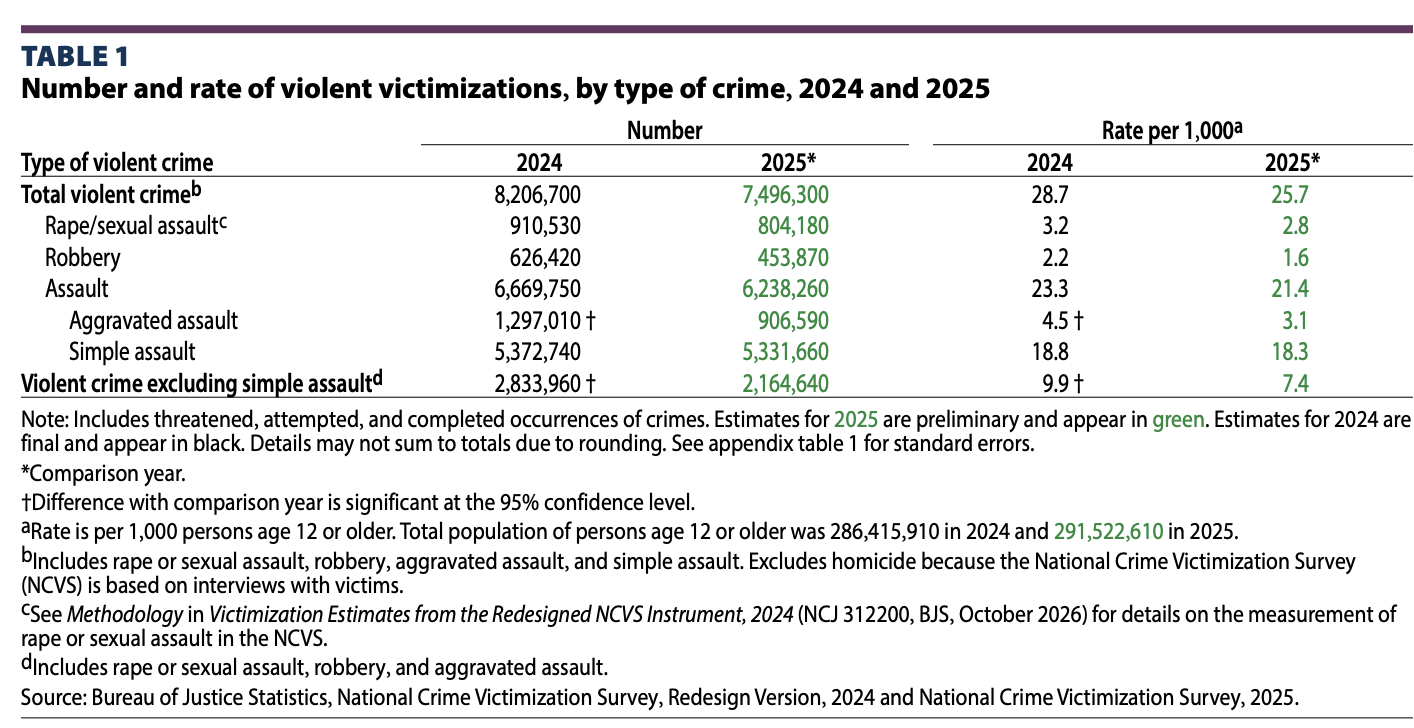
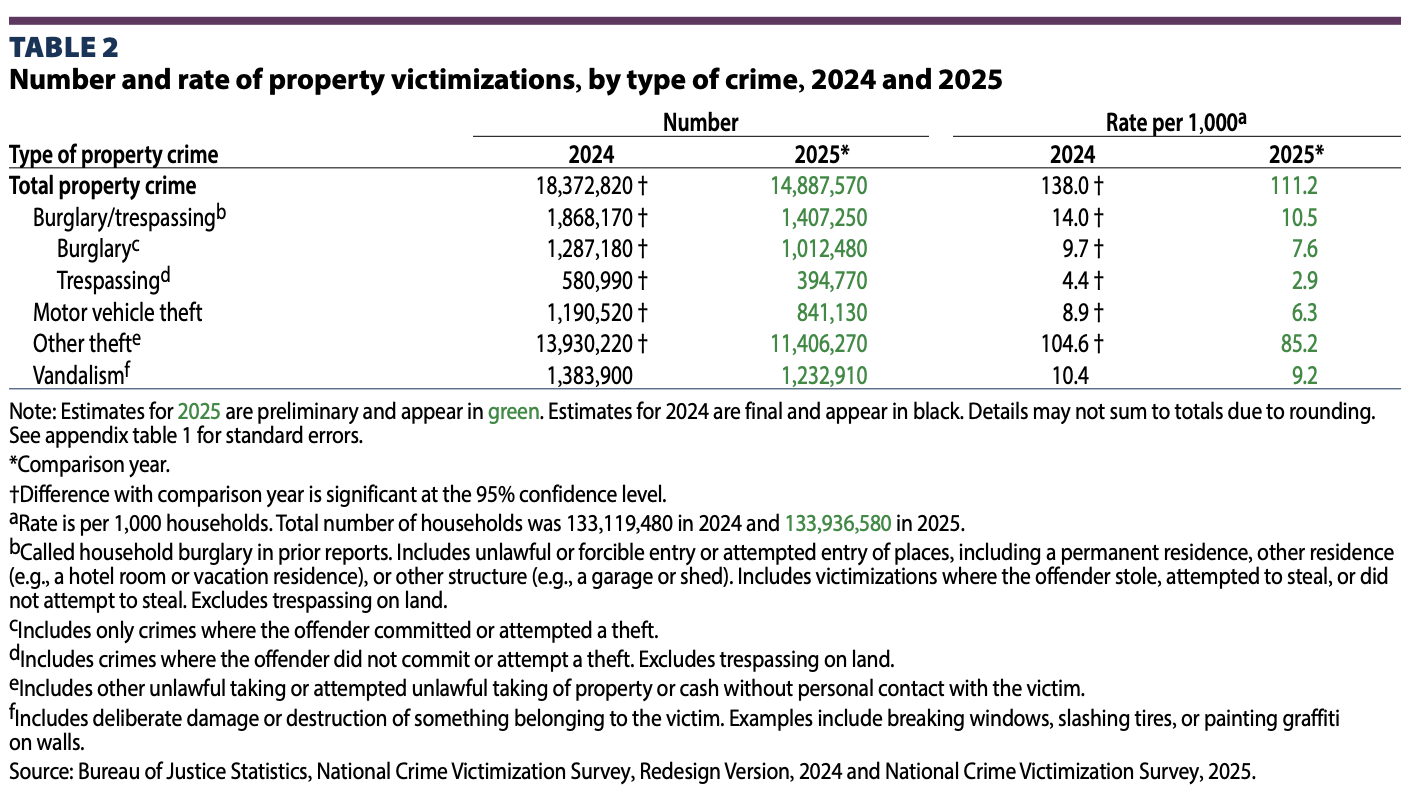
The rate of violent crime excluding simple assaults declined 25 percent, from 9.9 per 1,000 persons age 12 or older in 2024 to 7.4 per 1,000 in 2025, per a preliminary report from the Bureau of Justice Statistics (BJS) National Crime Victimization Survey (NCVS). Property crime also decreased.
The key question is how readers should interpret a 25 percent decrease in 2025 in rates of violent crime.
Feel free to stop here, but if you’re interested in the redesign of the National Crime Victimization Survey and how they got to the 25 percent reduction, then read on.
Dozens of national media outlets are reporting a 25 percent reduction in rates of violent crime in 2025 based on the new BJS report. Are they correct? See the copy from CBS News.
So when a news outlet says that “violent crime declined 25 percent,” readers may reasonably assume that the finding covers all violent victimization.
A more accurate description is that BJS’s preliminary estimate shows a 25 percent decline in serious violent victimization, excluding simple assault.
Simple assault is the largest violent crime category.
Simple assaults involve shoving, pushing, minor scuffles, offensive physical contact, or verbal threats that put someone in fear of immediate harm. If someone says that they are going to harm you after a physical encounter, and you believe that the offender has the capacity to hurt you, then it’s simple assault. Simple assaults create significant fear of crime.
Aggravated assaults involve an elevated attack that goes beyond basic physical contact by introducing dangerous elements or heightened intent or serious bodily injury such as broken bones, deep wounds requiring stitches, or damage to vital organs or the use of weapons.
News coverage that omits the exclusion of simple assault risks giving readers an overly broad impression of what BJS found.
The National Crime Victimization Survey
The redesigned NCVS uses revised questions and expanded prompts intended to identify criminal victimization more effectively. BJS expected the new instrument to produce larger estimates for many categories.
The National Crime Victimization Survey states that rates of violent crime increased 44 percent (based on findings from independent crime analysts) in 2022 and rates of violent crime remained essentially unchanged in 2023 and 2024. See below.
We now have a significant decline in rates of NCVS violent crime for 2025. But that finding needs a lot of explanation.
CrimeinAmerica.Net-Chat GPT’s “Top 10 Sources for Crime in America” based on primary statistical sources with trusted secondary analysis.
100 out of a possible 100 score based on website trust, content, and links, Gridinsoft.com and ScamDetector.Com.
Top ten source for crime news based on RSS feeds (publicians and universities importing articles from this site) per FeedSpot.
Author
Leonard Adam Sipes, Jr.
Former Senior Specialist for Crime Prevention and Statistics for the Department of Justice’s clearinghouse. Former Director of Information Services, National Crime Prevention Council. Former Adjunct Associate Professor of Criminology and Public Affairs-University of Maryland, University College. Former police officer. Retired federal senior spokesperson.
Former advisor to presidential and gubernatorial campaigns. Former advisor to the “McGruff-Take a Bite Out of Crime” national media campaign. Produced successful state anti-crime media campaigns.
Thirty-five years of directing award-winning (50+) public relations for national and state criminal justice agencies. Interviewed thousands of times by every national news outlet, often with a focus on crime statistics and research. Created the first state and federal podcasting series. Produced a unique and emulated style of government proactive public relations.
Certificate of Advanced Study-The Johns Hopkins University.
Author of ”Success With The Media: Everything You Need To Survive Reporters and Your Organization,” available at Amazon and additional bookstores.
Quoted by The Associated Press (multiple times), USA Today, Axios, A&E Television, the nationally syndicated Armstrong Williams Television Show (35 times), ABC News, Inside Edition Television, Oxygen and allied publications, Vox, Forbes, Newsweek, The Economist, The Toronto Sun, The Chicago Tribune, The Daily Beast, The Huffington Post, The Baltimore Sun, The Boston Herald, The Capital Gazette, MSN, AOL (multiple times), Yahoo (multiple times), Yahoo Canada, Yahoo New Zealand, JAMA, News Break, US News And World Report, The Hill (newspaper of Congress), NewsMax, Department of Justice documents, multiple US Supreme Court briefs, C-SPAN, the National Institute of Health, college and university online libraries, multiple books and journal articles, The National Institute of Corrections, The Office of Juvenile Justice And Delinquency Prevention, The Bureau of Justice Assistance, Gartner Consulting, The Maryland Crime Victims Resource Center, Law.Com, The Marshall Project, The Heritage Foundation via Congressional testimony, Law Enforcement Today, Law Officer.Com, Blue Magazine, Citizens Behind The Badge, Police 1, American Peace Officer, Corections.Com, Prison Legal News, the Journal of Offender Monitoring, Yomiuri Shimbun (Asia’s largest newspaper), LeFigaro (France’s oldest newspaper), Homeland Security Digital Library, The ABA Journal, The Daily Express (UK), The Independant (UK), The Seoul Economic Daily (Korea), The Albanian Post, The Harvard Political Review, The Millennial Source, The Federalist Society, Lifewire, The Beccaria Portal On Crime (Europe), The European Journal of Criminology, American Focus and many additional TV stations and publications.
Sign up to receive notifications about new articles on the front page of this site.
A comprehensive overview of crime for recent years is available at Violent and Property Crime Rates In The U.S.
Analysis
The report below represents preliminary data from the USDOJ’s National Crime Victimization Survey (NCVS) offered by the Bureau of Justice Statistics (BJS). An expanded analysis and charts are below.
The National Crime Victimization Survey is the nation’s primary source of information on criminal victimization occurring in the United States.
The NCVS is administered to persons age 12 or older from a nationally representative sample of U.S. households. The survey collects information on nonfatal personal and household property crimes, including those that are reported and not reported to police.
To my knowledge, the BJS has never issued a preliminary crime report in the past. Yes, there is an upcoming national election.
The NCVS is considered to be much more accurate than crimes reported to law enforcement, as offered by the FBI. The numbers for the NCVS are much larger than FBI data and, generally speaking, the larger the numbers, the more accurate the findings. Both measures have limitations. The NCVS is subject to sampling and reporting error; FBI statistics depend on crimes becoming known to police and on agency reporting.
Other countries use the same crime survey philosophy because the majority of crimes there are also not reported to the police thus the need for surveys to understand the full scope of crime.
How BJS Compared 2025 With 2024 Using Its Redesigned Survey
BJS says that older data before 2025 is not part of their new redesign.
But in using 2024 data, BJS divided the NCVS sample between the old and redesigned questionnaires. That allowed it to produce two separate sets of estimates for the same year.
The regular (legacy) Criminal Victimization, 2024 report used the old questionnaire, while the subsequent redesign report presented the new questionnaire’s estimates. In January 2025, BJS fully transitioned to the redesigned instrument.
This allowed BJS to compare their redesigned 2025 findings with 2024 data using the redesigned instrument.
Interesting Things To Consider
This discussion provides concrete evidence that the NCVS redesign affects the estimates and results, rather than merely a general warning that the survey has changed.
The 2025 report is preliminary. To my knowledge, the BJS hasn’t used preliminary reports in the past.
The final will be interesting to read to see if the 25 percent violent rate reduction holds. FBI preliminary crime reports tend to cite more crime than final reports (but they are two entirely separate counts of crime using different criteria).
The 2025 BJS report excluded simple assaults, the largest category for violent crime.
When simple assault is included, the overall rate of violent victimization fell from 28.7 per 1,000 persons age 12 or older in 2024 to 25.7 in 2025. That represents a decline of approximately 10.5%, rather than 25%. BJS’s table does not identify this overall decline as statistically significant at the 95% confidence level. The 25% decline in violent victimization excluding simple assault, by contrast, is statistically significant at that level.
The exclusion of simple assault does not, by itself, explain the decline. Simple assault is excluded from both sides (2025 versus 2024) of the 25 percent reduction in rates of violent crime comparison. The decline is what BJS reports for the remaining violent crime categories.
The rate of violent victimization in the 2024 NCVS-R (using the new research instrument) was 28.7 victimizations per 1,000 persons age 12 or older. This rate was 23% higher than the rate of violent victimization in the 2024 NCVS-L (using the old instrument—23.3 per 1,000). Violent victimization included rape or sexual assault, robbery, aggravated assault, and simple assault.
It’s hard to understand how this experiment uses the new research instrument (the redesigned survey uses revised questions and expanded prompts intended to identify criminal victimization more effectively) and created a 23 percent increase in violent crime in 2024 (beyond already high rates of violent crime in 2024), yet 2025 NCVS results offered a 25 percent decrease in violent crime.
However, the 23 percent increase in 2024 does not disprove the preliminary 25 percent decline for 2025. The two percentages measure different things. The 23 percent figure compares two survey instruments in the same year (2024) and includes simple assault. The 25 percent decrease in 2025 compares 2024 with 2025 using the redesigned survey and excludes simple assaults for both.
The 2025 NCVS weights used in this report include a one-time adjustment to account for the absence of data due to missing interviews in October and November, during the lapse in federal government appropriations. BJS adjusted the survey weights to account for the missing interviews.
This adjustment enables the 4 months of data collected in July, August, September, and December of 2025 to represent the second half of 2025.
National Crime Victimization Survey Reports For Recent Years—Huge Increase In Violent Crime Until 2025
Now, the Bureau of Justice Statistics states that, per preliminary data, the rate of violent crime declined 25 percent in 2025.
BJS excluded simple assaults in its 2024-2025 preliminary report.
Excluding simple assaults from the BJS preliminary report makes a big difference. In 2024 (the last full NCVS report), simple assaults were 4,126,640 and aggravated assaults numbered 1,341,950.
The last full NCVS report from the BJS in 2024 recorded 5,468,590 assaults (both aggravated and simple) out ot a total of 6,671,640 violent crimes.
Yet simple assaults were not used in the 2024-2025 NCVS redesigned comparisons; thus, the exclusion became a moot point. But it remains very important when describing the finding to the public: the 25 percent decline does not cover all violent victimization.
Is The 25 Percent Reduction in the 2025 Rates Of Violent Crime Accurate?
I don’t think that the Bureau of Justice Statistics would create inaccurate crime statistics, but the redesign raises a lot of interesting questions mentioned in this article.
The NCVS-R instrument (the new survey) incorporates expanded screener probes and more behaviorally specific language to improve measurement, so BJS expected that it would produce larger estimates of victimization. That obviously did not happen for the 2025 decrease.
The redesigned instrument produced higher estimates than the legacy instrument in the 2024 split-sample comparison. That finding helps demonstrate why the redesign matters.
The 25 percent decline reported for 2025 is a different comparison: it uses the redesigned instrument for both years and excludes simple assault.
FBI Data And NCVS Findings Show Decreases In Violent Crime
The FBI offers reported crime, not all crime, yet the great majority of media and public crime discussions will solely focus on FBI data, which poses ethical and journalistic challenges.
For the FBI’s 2025 report, violent crime decreased by an estimated 9.3%. Murder and nonnegligent manslaughter decreased by an estimated 18.1%. Rape decreased by an estimated 7.6%. Robbery decreased by an estimated 18.5%. Aggravated assault decreased by an estimated 7,2%. Violent crime also decreased in 2023 and 2024 and continues to decline in 2026.
So for the first time in several years, FBI data and NCVS findings show decreases in violent crime.
BJS Highlights–Violent Victimization Preliminary Estimates
In 2025, U.S. residents age 12 or older experienced 7.5 million violent victimizations—a rate of 25.7 victimizations per 1,000 persons age 12 or older.
The rate of violent crime (excluding simple assaults) declined 25%, from 9.9 per 1,000 persons age 12 or older in 2024 to 7.4 per 1,000 in 2025.
BJS Highlights–Property Crime Preliminary Estimates
Households in the United States experienced 14.9 million property victimizations in 2025.
The rate of property victimization declined 19%, from 138.0 per 1,000 households in 2024 to 111.2 per 1,000 in 2025.
Chart–Bureau of Justice Statistics Violent Crime
Chart—Bureau of Justice Statistics Property Crime
Conclusions
A 25 percent decline in serious violent victimization is encouraging news. But readers should understand exactly what the Bureau of Justice Statistics measured.
The preliminary estimate excludes simple assault and uses the redesigned National Crime Victimization Survey. It compares 2024 and 2025 using the redesigned instrument, and it may change when BJS publishes its final 2025 report in 2027.
The redesign also produced different estimates from the older survey instrument when both were used in 2024. That is an important reason to exercise caution when comparing the redesigned survey with the historical NCVS trend.
The 25 percent figure is BJS’s preliminary estimate for violent victimization excluding simple assault. It should not automatically be interpreted as a 25 percent decline in all violent victimization.
The FBI’s separate statistics also show a substantial decline in reported violent crime in 2025. But the FBI and NCVS measure crime differently, and their figures should not be treated as interchangeable.
The final BJS report, expected in 2027, will be important. For now, the responsible approach is to report the preliminary decline accurately, explain what it covers, and acknowledge the limitations of the data.
ChatGPT
ChatGPT fact-checked this article.
Privacy Policy
We do not collect your personal information. See our privacy policy at “About This Site.”
See More
See more articles on crime and justice at Crime in America.
Most Dangerous Cities/States/Countries at Most Dangerous Cities.
US Crime Rates at Nationwide Crime Rates.
National Offender Recidivism Rates at Offender Recidivism.
The Crime in America.Net RSS feed (https://crimeinamerica.net/?feed=rss2) provides subscribers with a means to stay informed about the latest news, publications, and other announcements from the site.